





| Author: Olimpia Orządała |
For several years now, staff of the University of Silesia in Katowice have been actively taking advantage of the opportunities for collaboration offered by the Transform4Europe alliance. One of the people involved in these international activities is Agata Cowan-Stronciwilk, PhD from the Faculty of Humanities of the University of Silesia, who has been collaborating with researchers and artists from partner universities since 2022.
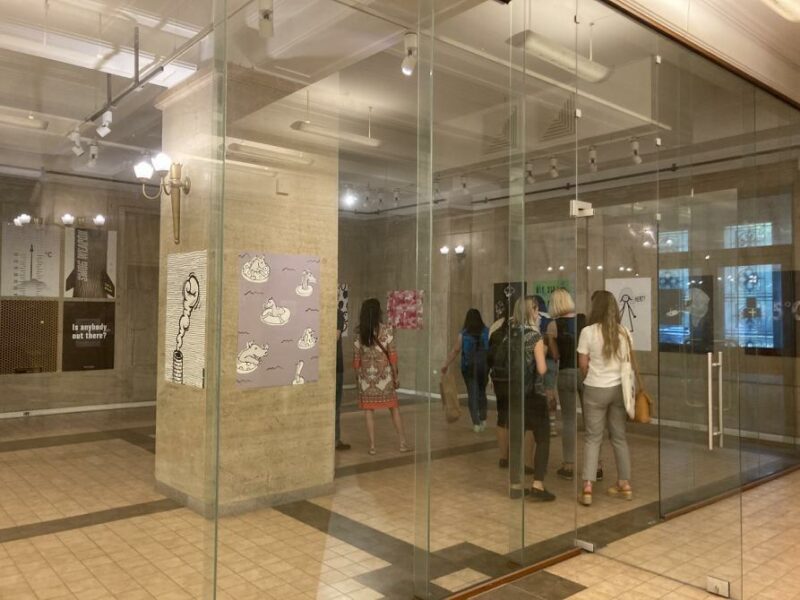
Exhibition in Sofia | Photo: private archive
”My involvement with T4EU began in 2022 with a visit as part of the Chair Exchange programme to Sofia University St. Kliment Ohridski. There, I taught a course on post-industrial heritage. During the workshops, participants designed new functions for selected post-industrial sites. Some very interesting, sophisticated projects emerged at that time,” recalls the researcher.
The stay in Sofia also marked the beginning of an exhibition collaboration with the local academic community. An exhibition of socially and environmentally engaged posters, ‘Art For Change’, prepared in collaboration with Tomasz Kipka, PhD, Assoc. Prof., was presented in the Rectorate. The exhibition was very well received and was the start of further joint initiatives. During her visit, A. Cowan-Stronciwilk, PhD also established a collaboration with Prof. Milena Blazhieva from Sofia University, who later visited Katowice and Cieszyn, where she gave a lecture to art history students on contemporary Bulgarian art.
“This was an opportunity for our students to get to know an artistic community that is relatively underrepresented in the Polish narrative of art history. Prof. Blazhieva spoke both about young artists and the latest trends in Bulgarian painting,” emphasises the researcher from the University of Silesia.
The collaboration that was established led to further exhibition projects. One of these was a presentation of works by students and lecturers from Sofia during the 6th Silesian Science Festival Katowice. In an expanded version, in collaboration with Stefan Lechwar, PhD, DSc, Assoc. Prof., the exhibition was later also shown at the Bulgarian Embassy in Warsaw and featured works by artists from Bulgaria and the artistic community of Cieszyn.
Another joint initiative was the exhibition ‘(In)visible Cities’, organised in 2024 in collaboration with Adam Czech, PhD, DSc, Assoc. Prof.. The exhibition was inspired by the work of Italo Calvino and presented artistic prints on the theme of the city—both real and imagined. Some of the works depicted places from the region, including Cieszyn and Bielsko-Biała.
“During the exhibition opening, it turned out that some members of the Polish Embassy in Sofia recognised places from their home regions depicted in the prints. It was a fascinating moment, illustrating how art can build bridges between different communities and experiences,” says the researcher.
A. Cowan-Stronciwilk, PhD’s work within T4EU also includes participation in academic events. Among other endeavours, she took part in the Common European Heritage Week in Trieste, where she presented issues related to the regeneration of post-industrial sites through artistic activities. In 2024, the researcher was invited as an expert to the International Summer School of Museology and Heritage organised by the University of Primorska in Koper in collaboration with UNESCO. During her lecture, she presented the results of comparative research into mining-related art in Upper Silesia and the Great Northern Coalfield region in northern England.
As the researcher emphasises, the greatest value of collaboration within the T4EU framework is the opportunity to build long-term academic relationships.
“Being part of this consortium allows us, above all, to forge connections that later lead to joint projects, exhibitions or educational initiatives. This also makes it easier to plan future activities and international projects,” says A. Cowan-Stronciwilk, PhD.
The researcher is currently planning further collaboration with T4EU partner universities, including the Universidade Católica Portuguesa. As she points out, the alliance also offers many opportunities for students, who can take part in projects, summer schools or international trips.
“It is worth keeping an eye on the information in the staff newsletter. Competitions and initiatives are regularly announced there, enabling the implementation of joint scientific, artistic and educational projects,” concludes the researcher.
The article ‘Art Without Borders’ was published in April issue No. 7 (337) of the University of Silesia Magazine.

Get inspired by experiences shared by students, PhD students and university employees who have participated in Transform4Europe initiatives – discover their stories about trips, research and international collaborations.