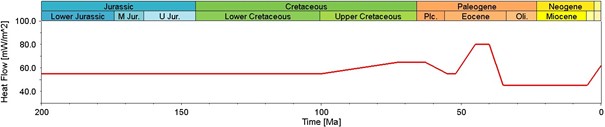





An article by M. Zielińska, K. Spunda, D. Plašienka and D. Botor entitled “Thermal records of Mesozoic and Cenozoic heat flow peaks as an expression of structural evolution interplay in the Western Carpathian northern suture” has been published in Marine Geoscience and Energy Resources (Elsevier; formerly Marine and Petroleum Geology). The study presents a quantitative reconstruction of the thermal history of the northern suture zone of the Western Carpathians based on data from the Hanušovce-1 borehole.
The paper introduces an integrated approach combining detailed analysis of organic matter maturity indicators with one-dimensional modelling of burial history and heat flow evolution, calibrated against stratigraphic and structural data. A key methodological innovation is the development of sequential paleo-models corresponding to successive thrusting stages. This framework enabled the separation of thermal effects related to individual deformation phases and the reconstruction of their amplitude and duration.
The results demonstrate a differentiated character of heat-flow peaks during the Mesozoic and Cenozoic. The Cretaceous collision is recorded as a gradual, relatively low-amplitude increase in heat flow, whereas the Eocene collision produced a short-lived but pronounced high-intensity peak. These findings provide quantitative evidence for a close coupling between collisional dynamics, thrust kinematics and the thermal response of rocks within the collision zone.
The novelty of the study lies in the quantitative demonstration that the paleothermal record of the northern segment of the Western Carpathians is polyphase in character and directly controlled by the sequence of tectonic events rather than by a uniform regional thermal regime. Maximum paleotemperatures, locally reaching approximately 180 °C, indicate significant variability in organic matter maturity among structural units, with implications both for reconstructing the geodynamic evolution of the orogen and for interpreting the history of petroleum systems in collisional settings.
The publication constitutes a significant contribution to the discussion on mechanisms responsible for generating thermal anomalies in orogenic belts and on the relationship between tectonic deformation and thermal evolution within continental suture zones.
Source: DOI: https://doi.org/10.1016/j.marger.2026.207654
Note’s author notatki: Magdalena Zielińska