




The laboratory conducts precise quantitative analyses of chemical elements using Atomic Absorption Spectroscopy (AAS). It enables accurate determination of metals and selected nonmetals in trace amounts within both liquid and solid samples. Owing to its high sensitivity, selectivity, and measurement reproducibility, the AAS method serves as an indispensable tool in materials science, environmental, and biological research. The operating principle of the spectrometer is based on the absorption of radiation at characteristic wavelengths by free atoms of a given element. The sample is introduced into an atomizer, where it is decomposed into gaseous atoms, and the measured absorbance is proportional to the concentration of the analyzed element. For each element, a dedicated hollow cathode lamp emitting radiation at a specific wavelength is used, ensuring high precision and selectivity of the determinations.
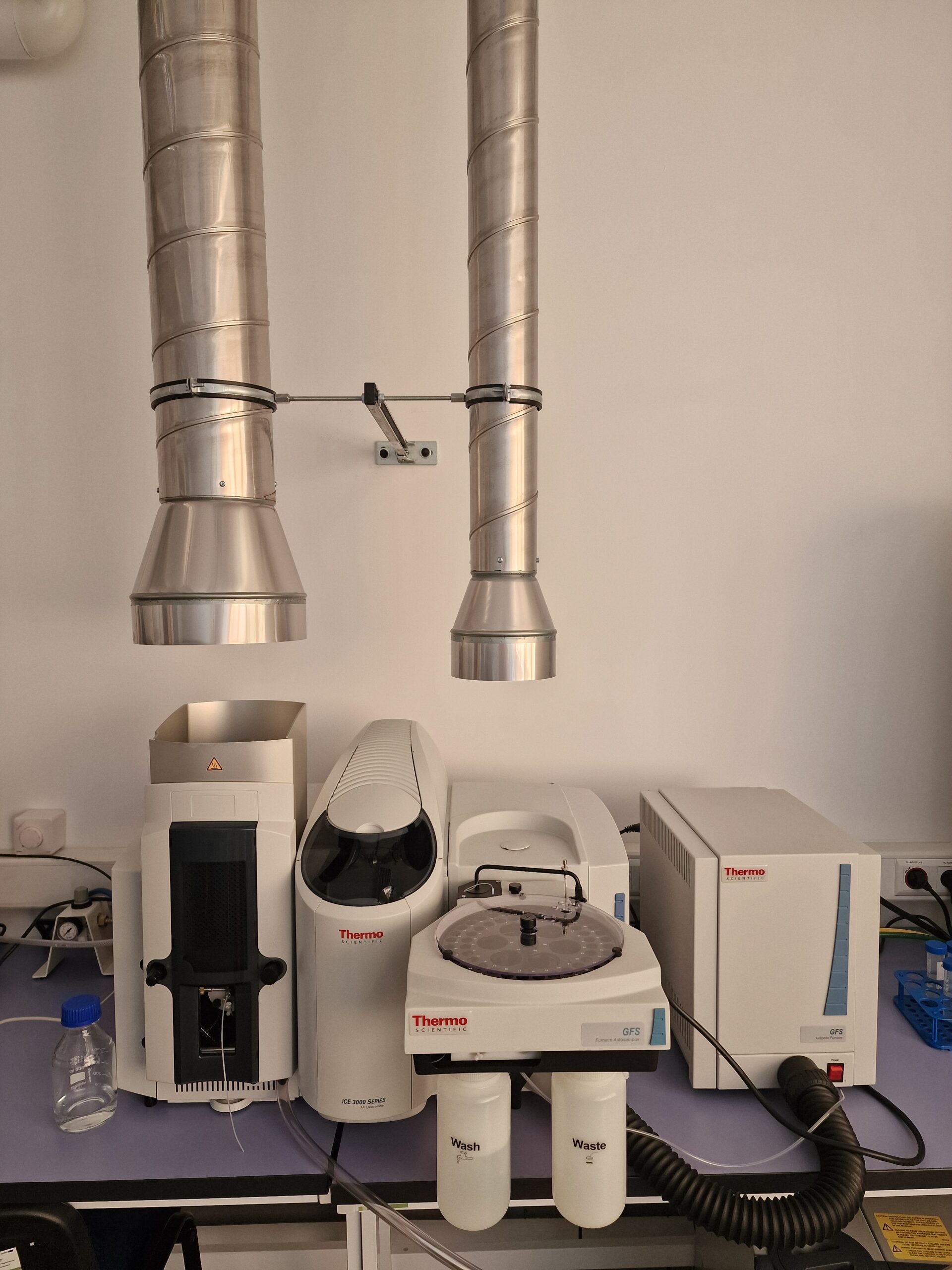
- Atomic Absorption Spectrometer iCE 3500 (Spectro-Lab)
The iCE 3000 series spectrometer is equipped with both a flame and graphite furnace module, enabling quantitative determination of metals and selected nonmetals (Cu, Ag, Au, Fe, Co, Pb, Zn, Ca/Mg, Ni, Ti, P) in various types of samples, including aqueous solutions, environmental extracts, biological materials, solid samples after mineralization, and suspensions. The instrument features an automatic double-beam optical system with a six-position lamp turret, a high-resolution Ebert monochromator, and a photomultiplier operating in the 180–900 nm range. The system offers computer-controlled wavelength selection, automatic peak search, and background correction using the QuadLine method. A titanium burner (50 mm) with laminar flow and adjustable working angle allows operation with acetylene/air or acetylene/nitrous oxide flames, ensuring high sensitivity and measurement stability.
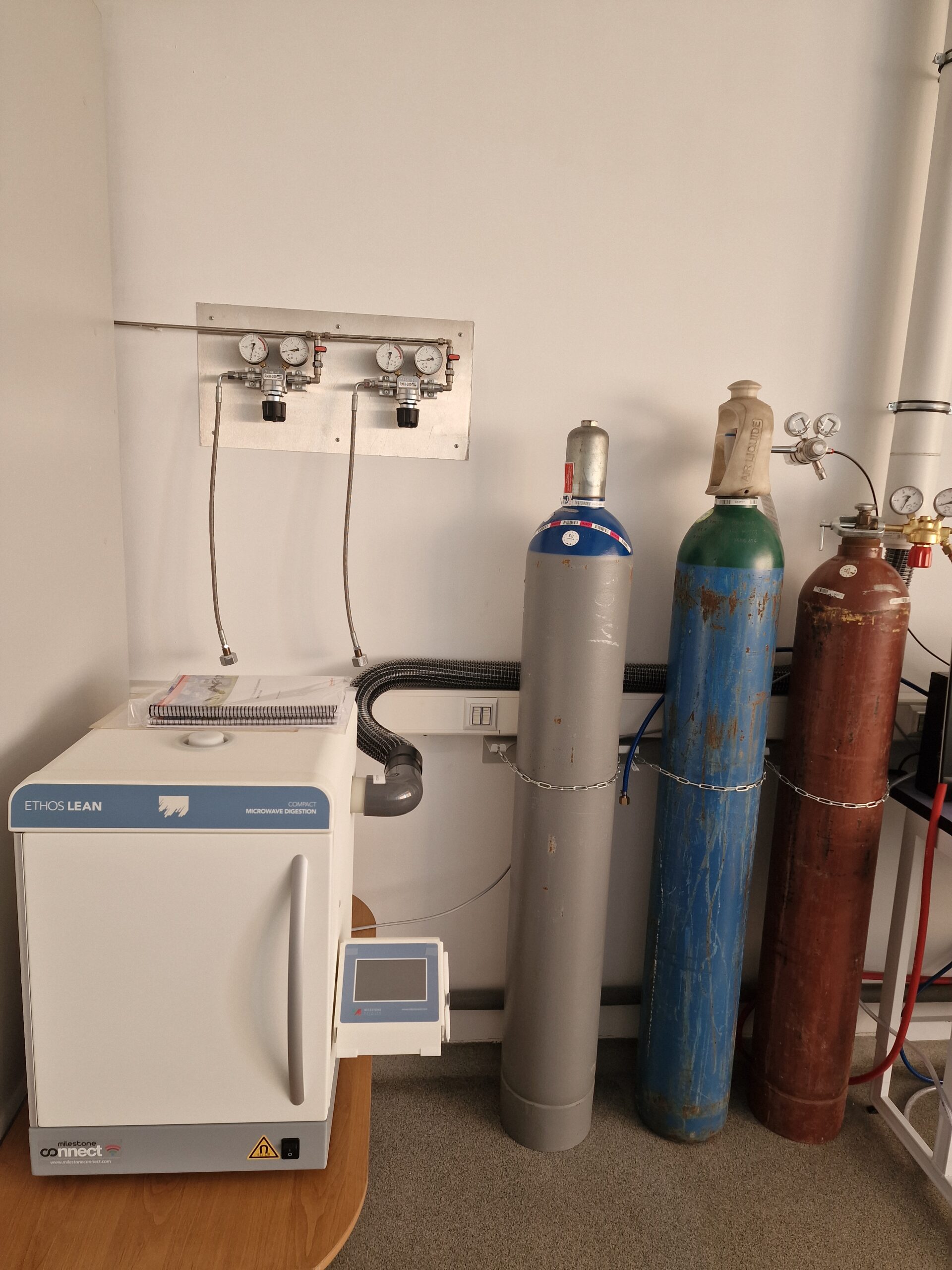
- Microwave Digestion System ETHOS LEAN (Milestone)
This device is designed for rapid and safe sample digestion in closed high-pressure vessels. The acid-resistant stainless-steel chamber coated with PTFE and a mechanical diffuser ensure uniform microwave distribution. Two magnetrons with a total power output of 1900 W and an infrared (IR) temperature sensor enable dynamic temperature control up to 300°C. The 14-position rotor with TFM vessels (100 mL, 35 bar, 300°C) includes a pressure monitoring system, allowing the digestion process to continue without interruption. The system complies with EN61010 and EN61326 standards and is fully compatible with US EPA methods 3051A, 3052, 3546, and ASTM D6010.
- DigiBlock ED36S Heating Block (LabTech)
The DigiBlock heating system enables uniform sample heating from ambient temperature up to 210°C with high thermal stability (ΔT = ±0.2°C). It allows simultaneous processing of up to 32 tubes (50 mL) in accordance with EPA and other international analytical standards. The stainless-steel heating surface provides even heat distribution, while the use of disposable low-contamination polypropylene tubes eliminates the need for preliminary acid cleaning or digestion.