





| Author: Olimpia Orządała |
Kyrgyzstan, a country located in Central Asia, is about 6,000 kilometres away from Poland. It is home to an ethnically diverse population, the majority of which consists of Kyrgyz people (about 70%). It’s not a popular holiday destination. It does, however, attract mountain lovers, as mountains cover a significant part of the country’s surface – with the Tian Shan being the most important mountain range. Akylaj Abylkadyr kyzy, PhD, a collaborator of the School of Polish Language and Culture of the University of Silesia in Katowice, comes from Kyrgyzstan.
Abylkadyr kyzy has always been interested in foreign languages. After completing primary school, which lasts 11 years in Kyrgyzstan, she wanted to study Turkish Studies. Ultimately, she chose Polish Studies at the Kyrgyz National University in Bishkek, starting from the beginner level (A0). She came to Poland to complete her Master’s degree. As part of language internships, she studied at the University of Silesia in Katowice and the Adam Mickiewicz University in Poznań.
‘Our first USil lector, Maciek Chowaniok, passed on his passion for Polish culture and language to us. He was the one who motivated me to continue my studies. My internship at the USil School of Polish Language and Culture was another turning point, which convinced me that I wanted to dedicate my future to Polish. The lecturers had a fantastic way of explaining the Polish language and its grammar in a clear and understandable way. I do not regret choosing this path. Knowledge of the Polish language has opened up many new possibilities for me. I never planned for Poland to become such an important part of my life, but as the saying goes, man proposes, God disposes. Sometimes, life doesn’t go as planned. Today, I can safely say that Poland has become my second home. Of course, Kyrgyzstan will always be number one in my heart’.
At the University of Silesia in Katowice, she completed not only her Master’s but also her doctoral degree.
‘My doctoral dissertation focused primarily on the Kyrgyz worldview reflected in Kyrgyz names. I tried to give an insight into the culture and history of Kyrgyzstan. I paid particular attention to the etymology of the word Kyrgyz. I also discussed onomastics – the study of names. In Kyrgyz culture, names are very important. It is common for close family members to help choose a name for the baby. These are some male name examples: Adilet (meaning ‘truth’ and ‘justice’), Nurbek (nur for ‘radiance’ + bek for ‘strong’ = ‘strong radiance’), and female: Akylaj (akyl for ‘wise’ + aj for ‘moon’ = ‘wise moon’), Nurajym (nur for ‘radiance’ + ajym for ‘woman’ = ‘radiant woman’)’, explains A. Abylkadyr kyzy.
For several years, the researcher has been working with the USil School of Polish Language and Culture, where she occasionally delivers lectures and shares her knowledge about Kyrgyz culture and history.
It is widely believed that foreigners find it difficult to learn Polish. A. Abylkadyr kyzy admits that before her studies, she had never heard the Polish language spoken live, so learning it was quite a challenge. The previously mentioned Polish lector said that he didn’t speak either Russian or English, and that he knew only Polish (as it later turned out, he did know English). During his lectures, he explained everything by drawing on the board.
‘When my friends and I first came to Poland for a language internship, a funny thing happened. We were at the railway station in Warsaw and wanted to buy tickets to Katowice. We knew how many tickets to buy and where to, but we completely forgot that when the other person replied, we actually had to understand what they were saying. The booking clerk told us the price, but all I heard was a rustling sound’, recalls A. Abylkadyr kyzy.
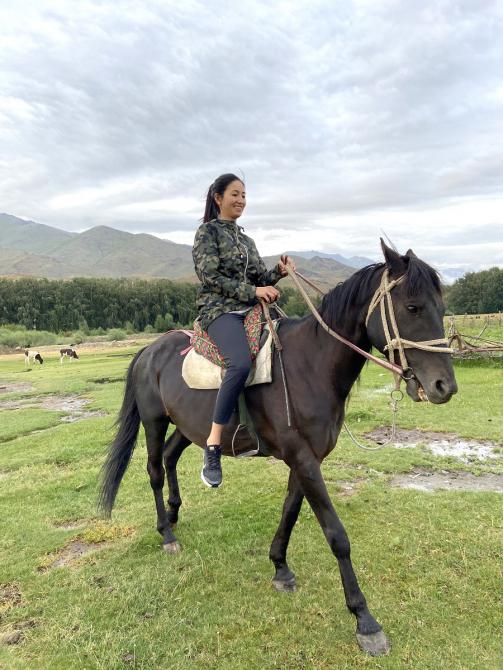
Akylaj Abylkadyr kyzy, PhD | private archive
Kyrgyz belongs to the Turkic group of languages and is agglutinative (words are created by stringing together word parts, each expressing a specific meaning), unlike Polish, which belongs to the West Slavic languages and is inflected (only word endings change, and each of them can have multiple meanings at once). Kyrgyz people also use a different alphabet – Cyrillic script. A. Abylkadyr kyzy admits that what she loves the most about the Polish language is its grammar.
In Kyrgyzstan, there is the Polish Cultural and Educational Association ‘Odrodzenie’. It’s a place where people with Polish roots or those who are interested in Polish can learn this language. A. Abylkadyr kyzy highlights that Kyrgyz people have always had some sort of knowledge about Poland – their first associations being Warsaw and John Paul II. Currently, this knowledge is expanding due to the popularity of Polish brands (especially in the cosmetic industry) and the ongoing situation in Ukraine. Many Kyrgyz people come to Poland to earn money. More and more people are interested in studying Polish as a foreign language as well. In Poland, however, knowledge about Kyrgyzstan is still quite limited, although the situation is certainly changing for the better.
‘When I told people where I was from, they imagined yurts (tents), horses and wildness, assuming that there was nothing else out there in Kyrgyzstan. When I talked about my country during presentations, people would ask questions like: Do you have normal houses there? Yes, we live in houses. We are 6,000 km away from Poland, so it’s no surprise. People who are interested in non-touristic places are much more aware of Kyrgyzstan’, says A. Abylkadyr kyzy. ‘Meanwhile, the biggest stereotype about Poles was that they complain a lot. Having lived here so many years, first in Katowice, now in Łódź, I’ve come to realise that it really is a national trait. Looking at life in both countries, however, I believe there is nothing to complain about’.
With Islam being the dominant religion in Kyrgyzstan, there are noticeable cultural differences between this country and Poland. There are very few similarities – hospitality is one of them. In Kyrgyz culture, guests in the house are considered sacred. They are served the finest food and treated with great respect, much like in Poland. A. Abylkadyr kyzy thinks that you should never bring your own rules into another person’s home. That’s why she wouldn’t change anything about Polish culture, which she deeply respects – and as she says, she loves Poland. She was most delighted by the Christmas atmosphere and the singing of carols.
‘When I was studying in Kyrgyzstan, my friends and I would always prepare Christmas Eve dinner. One of the lecturers told us that in every Polish home, Christmas Eve begins with prayers and the singing of carols. That’s how I pictured it for a long time. When I was first invited to a traditional Christmas Eve dinner in Poland, I couldn’t wait for the moment we would all start singing Christmas carols. To my great disappointment, the moment didn’t come. As it turns out, Christmas carols are not sung in every Polish home’, laughs A. Abylkadyr kyzy.
The cuisine is also different. Kumis (кымыз – kymyz) is a signature drink. It’s made from fermented mare’s milk. In the summer, when it’s hot, many people drink максым (maksym), which is made from fermented grains. There are also traditional dishes: шорпо (shorpo) – mutton, potato and carrot broth, куурдак (kuurdak) – potatoes with meat and оромо (oromo) – thin dough layered with vegetables and meat, steamed. And some popular snacks: казы карта (kazy karta) and чучук (chuchuk) – sausage-like dishes made from horse meat.
‘During my studies, I was always told that when I visited Poland, I had to try pierogi with sauerkraut and mushrooms. When I arrived for my internship, my friends and I went to the shop to buy some pierogi and then cooked them back at the dormitory. After trying them, we decided they were not to our taste. It was only later that I realised homemade pierogi and the store-bought ones are a whole different story. I absolutely love pierogi now and often make them myself – along with żurek (Polish sour rye soup)’, says Akylaj Abylkadyr kyzy.
Although her journey with Polish began somewhat by chance, she doesn’t regret her choice. Her deep understanding of the Polish language and culture makes it easier to build relationships with Poles, both in daily life as well as in professional and formal settings. She understands the way Polish people communicate – in a humorous and sometimes ironic way – which helps her read people’s emotions and intentions more accurately. This cultural awareness helps her avoid misunderstandings and makes it easier to understand other people.
The article entitled ‘6,000 Kilometres out of Love for Grammar’ was published in the May issue of the University of Silesia Magazine, no. 8 (328).
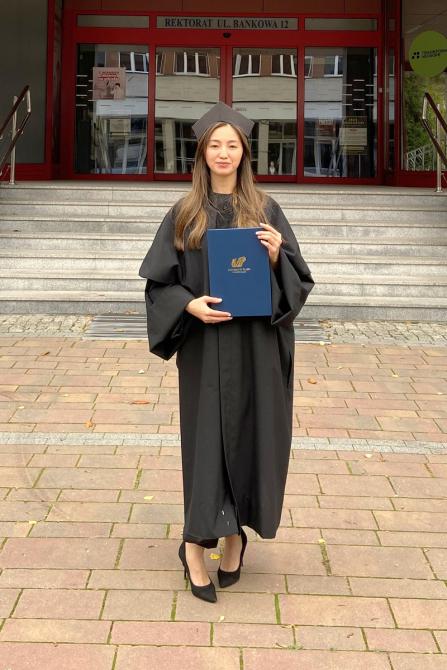
Akylaj Abylkadyr kyzy, PhD after receiving her PhD diploma | private archive