





In the 1970s, Jolanta Wadowska-Król became interested in the children falling ill in Szopienice and publicised the scale of the problem of lead poisoning, which was rampant among the youngest residents of Katowice. The communist authorities, seeking to avoid controversy, hindered her work and prevented her from defending her doctorate. In 2021, as a recognition of her dedication and research, the University of Silesia presented her with the highest academic honour – an honorary doctorate degree. In 2021, Lucyna Sadzikowska, PhD, DSc, Assoc. Prof., with the support of Jolanta Wadowska-Król herself, began fieldwork in Szopienice. By conducting interviews with former patients and their families, she gathered narratives that record and organise the multifaceted history of the ill and their loved ones, the Szopienice community, the industrial disease, and the industrial heritage of this district of Katowice. Above all, these stories provide a picture of Jolanta Wadowska-Król’s herstory and her role in the social campaign to combat lead poisoning. Today, the fictionalised story of her work is presented in the series Lead Children, which will premiere on Netflix on 11 February.
Despite the difficulties imposed on her by the government at the time, Jolanta Wadowska-Król tirelessly fought to improve the health of children living near the Szopienice Non-Ferrous Metal Smelter. Her actions helped in saving thousands of children, for whom treatment was arranged. Houses located immediately adjacent to the smelter’s chimney were demolished, and families with children returning from sanatoriums after treatment were moved to apartments farther away from the source of the pollution. The fact that the medic was prevented from defending her doctoral degree during the communist era was a shameful remnant of communist censorship. The University of Silesia attempted to reward Jolanta Wadowska-Król’s long-standing efforts when it awarded her an honorary doctorate in 2021.
As part of the honorary degree ceremony, the University of Silesia prepared a documentary short film presenting the work of Jolanta Wadowska-Król, entitled The Mystery of the Szopienice Children Poisoning, which can be viewed on the University’s YouTube channel.
In the last years of her life, Jolanta Wadowska-Król remained involved in social activities and willingly supported the efforts of Lucyna Sadzikowska, PhD, DSc, Assoc. Prof., Deputy Dean for Development at the Faculty of Humanities of the University of Silesia and Director of the newly established Jolanta Wadowska-Król Centre for Post-Industrial Environment Research at the University of Silesia, who undertook the task of preserving the memory of those events.
The Centre aims to strengthen the research, scientific, organisational, and teaching potential of the University of Silesia in initiating and implementing scientific projects and tasks. Until now, the University of Silesia lacked a unit that would provide an avenue for interdisciplinary research on the post-industrial environment. Illuminating the effects of regional industrialisation from a scientific perspective, and considering interdisciplinary solutions for both relief and preventive action, aligns with the work of engaged humanities, earth sciences, and studies on sustainable social development. The impact of the exploitation and processing of non-ferrous metals is an issue that urgently requires the involvement of representatives of various scientific disciplines. The creation of the Centre was inspired by the work of Jolanta Wadowska-Król.
The researcher from the University of Silesia, wanting to uncover the accounts of Szopienice witnesses, developed a close relationship with Jolanta Wadowska-Król:
“I felt it was worth talking to them. I think doctor Wadowska-Król felt the same way, so she decided to help me. She accompanied me during most of the conversations. Her name opened many doors. Afterall, people didn’t necessarily have to agree to meet with someone like me, who was a complete stranger to them,” said Lucyna Sadzikowska, PhD, DSc, Assoc. Prof., in an interview for the semi-annual journal No Limits, in which she spoke about her research. The result of her work is a scientific publication in the University of Silesia’s semi-annual Narracje o Zagładzie (Narrations of the Shoah), titled ‘«I Simply Did My Job». Lucyna Sadzikowska Interviews Jolanta Wadowska-Król’; an article published by the University of Silesia Press entitled ‘The Lead Worlds of Silesia. In the Zone of Post-Industrial Diseases of Jolanta Wadowska-Król’, as well as an article ‘The Szopienice community’s response to the consequences of lead exposure in the 1970s – attitudes and knowledge (humanistic perspective)’.
Jolanta Wadowska-Król, also known as “Our Lady of Szopienice,” or “the Silesian Erin Brockovich,” passed away on 18 June 2023. The Netflix series, which will premiere on 11 February, was born out of the desire to celebrate her legacy. The production is directed by Prof. Maciej Pieprzyca of the Krzysztof Kieślowski Film School at the University of Silesia.
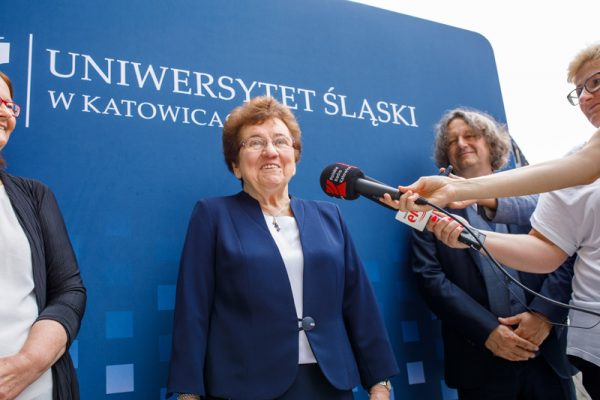
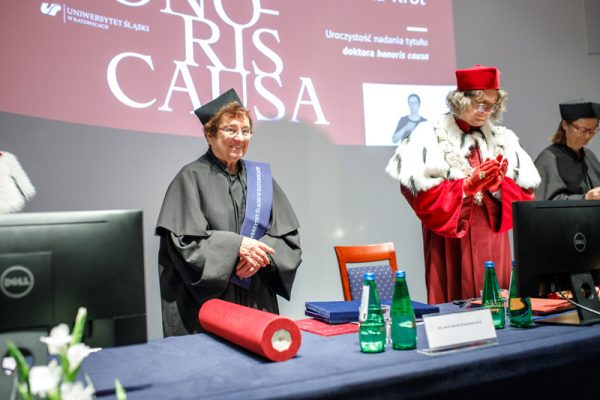
In 2021, Jolanta Wadowska-Król was awarded an Honorary Doctorate Degree of the University of Silesia | Photo by Julia Agnieszka Szymala