





| Author: Agnieszka Sikora, PhD |
Looking back at the origins of the Solar System, one can’t help but wonder what the oldest objects to be found within it are. These are meteorites that originated in a young protoplanetary disk surrounding the forming Sun. During the early stages of the solar nebula, the dust heated and melted rapidly. In these conditions, the molten matter particles crystallised, forming spherical structures called chondrules. Over time, chondrules and fine dust matter underwent accretion, forming primary meteorites called chondrites.
Krzysztof Szopa, PhD, DSc, Assoc. Prof. is a petrologist, mineralogist and geochemist. He works at the Institute of Earth Sciences at the Faculty of Natural Sciences of the University of Silesia in Sosnowiec. He specialises in the classification and characterisation of meteorites, as well as the dating of rocks. He is the discoverer of the first fossil meteorite in Poland and the co-discoverer of Polish moldavites – a form of tektite, which is natural glass formed by an asteroid impact in present-day Bavaria.
‘My daily work involves rock dating – or more precisely, determining the age of the process that formed a given mineral or rock. I am able to determine the age of the matter by exploiting the radioactive decay in the U-Pb system. I have to then interpret what that result actually means, as the process itself might pre- or post-date the mineral’, explains the scientist.
How did meteorites form?
Chondrites are one of the oldest types of solid matter in the Solar System, dating back over 4.5 billion years. Carbonaceous chondrites are a class of meteorites rich in carbon, organic compounds and water bound within hydrated minerals, making them a crucial source of information about the chemistry of the early Solar System. Unlike many other meteorites, they did not undergo significant differentiation. Because of this, their composition remained close to that of the primary protoplanetary disk matter. Studies of their composition and the presence of organic compounds suggest that they may have played a vital role in delivering water and the precursors of life to the early Earth.
Other meteorites underwent differentiation: they collided with each other, allowing elements to migrate, melt, form alloys and undergo exsolution. Iron meteorites (siderites) are an example of such objects. These are fragments of early planetesimal cores that originated within the first few million years after the Solar System formed, when heat from the decay of short-lived radioactive isotopes caused them to melt and separate into a metallic core made of iron, nickel and a silicate-rich mantle. Subsequent collisions of planetesimals shattered them, sending the metallic core fragments into outer space.
Another large group consists of stony-iron meteorites (siderolites). They are composed of a metallic core and a silicate mantle. In the non-metallic part, we can find mostly olivines, but also pyroxenes and plagioclases – materials that contain aluminium, silicon, calcium and iron in a non-metallic form.
Shooting stars
Shooting stars are small fragments of cosmic matter that heat up due to friction upon entering Earth’s atmosphere and then burn up almost entirely. Occasionally, however, much larger objects make it through, causing major catastrophes. The most famous example is the impact that led to one of the planet’s most spectacular mass extinctions, which resulted in the demise of the dinosaurs.
‘Studies of sediments from the bottom of the Gulf of Mexico indicate the presence of carbonaceous chondrite fragments. The object that struck this region around 65 million years ago was most likely a large asteroid-like body with a composition similar to a chondrite’, explains the geologist.
Such impacts were very common in past geological epochs. Modern-day Nördlingen in Bavaria, the place where Prof. Krzysztof Szopa conducted his research, is incredibly interesting for this very reason – an asteroid struck it almost 15 million years ago. The Ries and Steinheim craters are the remnants of this event. An object, or rather two fragments, that formed while passing through the atmosphere, struck the Earth, forming two craters.
‘The catastrophe must have been immense. I believe that rivers the size of the Danube flowing through the region changed their course within seconds’. The event also caused the rock material to detach and vaporise. It was partially melted and ejected into the air. As it fell and cooled, it turned into tektites. It was discovered in the sediments of the Vltava River and named vltavite (moldavite)’, says the scientist.
To this day, many rocks from this area bear traces of the catastrophe: they are melted and consist of crushed basement rock fragments and glass. The most characteristic is suevite – a type of rock found only at sites of major impact.
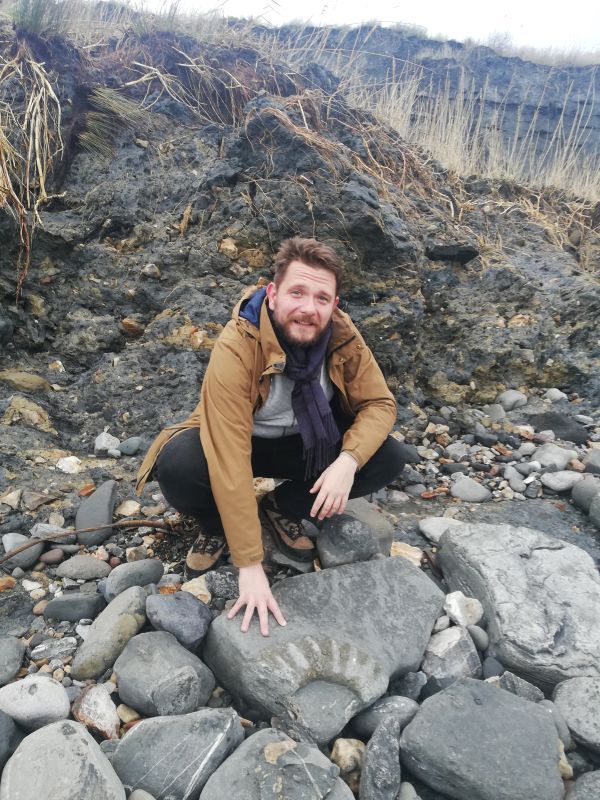
Krzysztof Szopa, PhD, DSc, Assoc. Prof. during fieldwork in Lyme Regis (Great Britain) | private archive
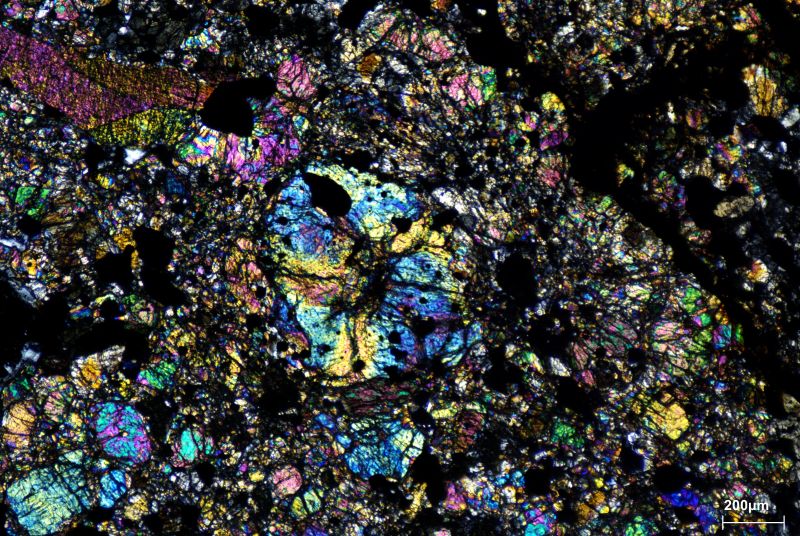
Drelów meteorite sample viewed under a microscope | photo by Krzysztof Szopa
Polish meteorites
Morasko is the best-known Polish meteorite. To this day, 1,500 of its fragments have been found, and their total weight reaches two tons. The meteorite fell as a meteor shower, and its fragments are still being found near Morasko – today’s Poznań district. The first fragment was found in the WWI trenches in 1914. It weighed about 77 kilograms. The object most likely fell around 3,500–5,000 years ago. It embedded itself into glacial deposits consisting of sand as well as boulder and varved clays. It left behind numerous craters, which are now filled with water and form small lakes. Today, this area is under environmental protection as part of the Morasko Meteorite Nature Reserve.
It’s an iron meteorite, which consists of minerals rich in iron, nickel, sulphur and carbon. They also act as carriers for trace elements such as cobalt, copper, gallium, germanium, arsenic, tungsten, gold and iridium. Moreover, the meteorite contains many rare minerals, some of which were newly discovered or co-discovered by scientists from the University of Silesia. The first two were moraskoite (2015) and czochralskiite (2016), discovered by Prof. Łukasz Karwowski from the USil Faculty of Natural Sciences. In 2025, a group of scientists led by Prof. Evgeny Galuskin discovered kryzaite. In early 2026, the Commission on New Minerals, Nomenclature and Classification of the International Mineralogical Association (CNMNC-IMA) approved another mineral, which was named kopernikite. The team investigating the new mineral consisted of scientists from several research centres, including: Prof. Evgeny Galuskin and Prof. Irina Galuskina from the USil Faculty of Natural Sciences, Prof. Eng. Joachim Kusz and Maria Książek, PhD from the USil Faculty of Science and Technology.
‘This may not be the end of discoveries. Other minerals found in the Morasko meteorite are being studied’, reveals Prof. Krzysztof Szopa.
Drelów is another Polish meteorite that is being studied at the University of Silesia.
‘The object’s flight was recorded by cameras belonging to the Skytinel Polish fireball network, which was founded by Mateusz Żmija. The object was tracked on 18 February 2026, and the first fragment was found near the village of Drelów in Lubelskie Province on 22 February. In total, 70 fragments, weighing about 3,900 grams were collected. We received a specimen for basic geochemical and petrographic research from a private collector Kryspin Kmieciak’, recalls the researcher.
Drelów is an ordinary chondrite with a black and glassy fusion crust. It is composed primarily of silicates, such as olivines and pyroxenes, as well as an iron-nickel alloy and sulphides. Distinct chondrules embedded in a fine-grained groundmass can be observed within its structure, although they have been partially altered by thermal processes.
Prof. Krzysztof Szopa has studied numerous meteorites throughout his career, including the so-called Lechówka palaeometeorite, found in an outcrop in Lechówka near Chełm. Its uniqueness lies in the fact that it was excavated from the sedimentary Cretaceous-Palaeogene boundary. Because no shock minerals were found in Lechówka’s sediments, scientists suggest that the geochemical anomaly could indicate a link to the Chicxulub impact event, which occurred approximately 65 million years ago in the Gulf of Mexico.
‘It is worth noting that this is not a fragment of the meteorite that led to, among other things, the dinosaur extinction. Most likely, a larger number of bodies were passing through the Earth’s atmosphere at that time, falling in various locations across the globe’, explains the scientist.
Prof. K. Szopa is currently studying another meteorite called Poświętno, which fell between Leszno and Zielona Góra at the end of July 2025. Preliminary analyses revealed that it’s an ordinary chondrite with a slightly glossy black fusion crust.
Meteorites are not merely geological curiosities. Above all, they are priceless matter samples, which enable us to reconstruct the earliest stages of the Solar System’s evolution. Each new specimen may potentially lead to another breakthrough, like the discovery of a rare mineral or previously unknown geochemical process, and each brings us closer to understanding how planets, and ultimately a life-sustaining environment, emerged from cosmic dust.
The article entitled ‘Messengers from Early Solar System’ was published in the April issue of the University of Silesia Magazine, no. 7 (337).