




| Author: Olimpia Orządała |
A text is no longer a linear narrative. It has become a multi-level arrangement of visual and semantic signposts. Magdalena Ślawska, PhD, DLitt, Assoc. Prof. from the Faculty of Social Sciences of the University of Silesia in Katowice studies this phenomenon. She emphasises that the graphisation of media discourse is not simply an aesthetic addition to content but one of the fundamental mechanisms of organising and interpreting text in media.
How Media Controls Our Attention
Contemporary press and websites increasingly rely on more than just words. By combining image, sound, typography and hypertexts into a single multimodal message, they become multicodal. Media linguists no longer understand the text solely through the prism of its verbal side. Theories about multimodality are already well developed, especially in the German Studies tradition, as Prof. Ślawska notes.
‘The word text itself is no longer purely linguistic. Nowadays, a text is composed of multiple modes. Media content functions within the intertwining of word, image, sound, graphic layout and interface’, explains the academic.
Graphisation involves not only illustrations and infographics but also titles, leads, typography – in other words, the page layout – as well as various types of text highlighting, such as pull quotes. Through these elements, authors guide readers through the text, suggesting a specific path of reception.
‘There are so-called strategic positions like titles, leads and subtitles in a text. They work similarly to road signs’, adds the researcher.
Essentially, what this means is that we do not so much read a text as find ourselves guided by it. Anything highlighted with colour or a larger font automatically becomes more important.
Together with journalism students, Prof. Magdalena Ślawska carried out an experiment during her classes. The aim was to examine the relation between the text and its visual presentation. First, the students spent an entire semester working on reportage texts and were then asked to match their content with graphic materials. They also evaluated ‘the best’ co-occurrence of the verbal and visual elements.
‘Their task was to identify which image matched a given text. They had no trouble with that. However, the experiment reversed the natural order of reception: the students were given the textual version first, and only later the visual one. In reality, rather than reading the text before the image, we process them simultaneously. Very often, we even focus on the image first’, explains the academic.
On the one hand, graphisation makes it easier to understand the content. On the other hand, it can lead to oversimplifying. A pull quote or a piece of clickbait can impose a specific interpretation of the text before we even get a chance to read it properly.
‘Therefore, graphisation is not only about structuring the text. It also serves a pragmatic function, as its aim is to attract our attention’, says Prof. Ślawska.
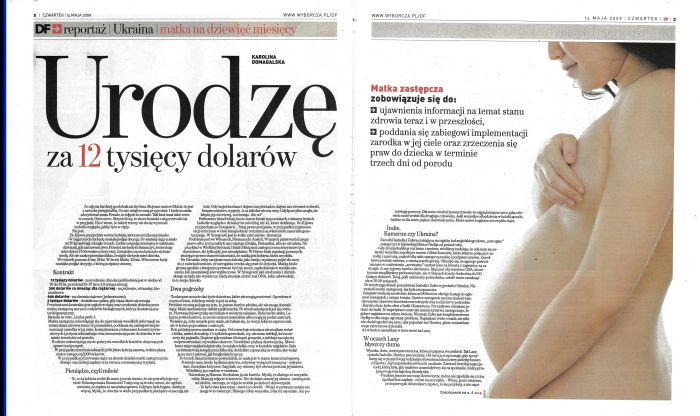
An article from Gazeta Wyborcza published on 14 May 2009 | Scans from texts by Magdalena Ślawska, PhD, DLitt, Assoc. Prof.
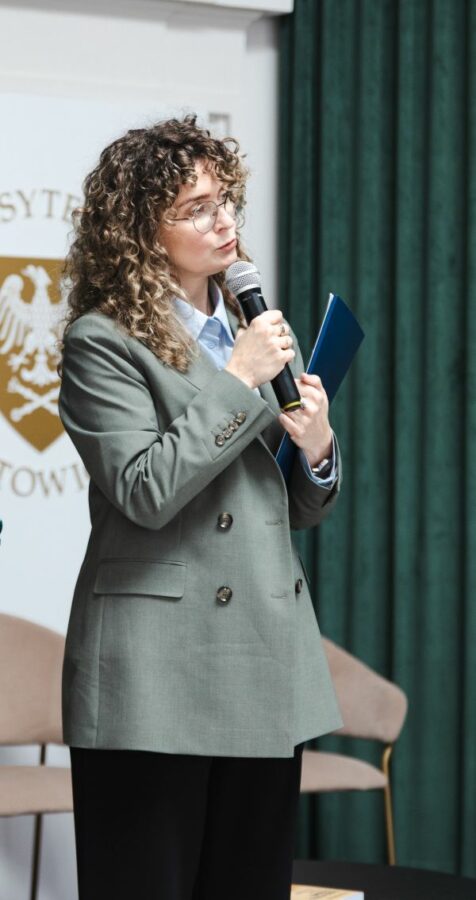
Magdalena Ślawska, PhD, DLitt, Assoc. Prof. | photo by Małgorzata Dymowska
Overload Paradox
The graphisation of media discourse is directly linked with the experience of information overload. Today, we live in an environment of constant message flow, notifications and stimuli. This overload stems from the characteristics of contemporary media. Furthermore, a recipient can become a producer.
‘Each of us can have their own media. This blurs the line between being the recipient and being the producer. We live in media noise’, notes Prof. Ślawska.
This is the main paradox of contemporary communication: the more means of production and reception, the greater the sense of overload and the need to limit exposure to stimuli. However, the experience of overload does not simply stem from the number of messages but also from the fact that they are algorithm-selected. Today, content is filtered and tailored to a specific user. As a result, we often find ourselves navigating through an algorithmic bubble – a closed loop of similar information.
Shortcut Culture
Paratextual forms play a vital role in contemporary media. The term paratext was introduced to describe the texts that surround the main text. The French literary scholar Gérard Genette metaphorically viewed paratexts as a vestibule or a threshold to the text. Most frequently, media texts are accompanied by visual shortcuts, previews, summaries or trailers. A shift is also visible within media genres themselves.
‘During one of my classes, I asked my students to try and identify traditional generic patterns in the social media reels they watch. They managed this with ease’, says Prof. Ślawska.
Even seemingly new forms of communication, such as short video materials called reels, are rooted in familiar journalistic genres, although they are often shortened and simplified.
‘Today, we operate largely at the paratext level. This means that our engagement with media or pop-cultural content is restricted to its condensed form. Consequently, we often find ourselves stuck in the “vestibule”. In contemporary media, we deal with conglomerates of paratexts. Wyborcza, Onet, Netflix, YouTube, Instagram – each of these media outlets has its own standard layout of paratexts that lead to specific texts. They can be considered self-promotional macrostructures’, notes the researcher.
Nowadays, news website homepages resemble a collection of visual previews – each element being both a piece of information and an incentive to click. Even the structure of content has been subordinated to the logic of a shortcut. The dominance of short media forms also shapes how content is received. Scrolling replaces reading, and the engagement with a text becomes superficial.
‘In the past, the lead was enough. Today, we have short summaries, audio versions, some sort of bullet lists and information on how long it will take to read the text. As a result, we no longer read the text but rather navigate between its pieces’, says the researcher.
The goal is not to reject new media forms, but to maintain a balance between rapid reception and sustained concentration. However, contemporary media do not make this any easier. Creators increasingly design their content in a way that fosters distraction. And so, we begin to use multiple screens at once’, says Prof. Ślawska.
The researcher emphasises the necessity of cultivating a deeper connection with the text, as this practice helps to develop sensitivity to both the text itself and its surroundings.
‘I encourage my students to read longer reportage texts and listen to podcasts. We practice reading and listening that requires greater involvement. It is becoming increasingly necessary to name the environment in which we operate. Showing students what happens when we talk and use the phone at the same time has nowadays become an essential part of teaching’, notes the academic.
What we observe in contemporary media from the perspective of visuality, audiality or broadly defined multimodality is a kind of dialogue between the producer and the recipient, between the visual and verbal side and between a text and its paratext. Recognising these mechanisms is essential, given how they guide us through contemporary culture.
The article entitled ‘Guided by Paratexts’ was published in the May-June issue of University of Silesia Magazine, no. 8–9 (338–339).
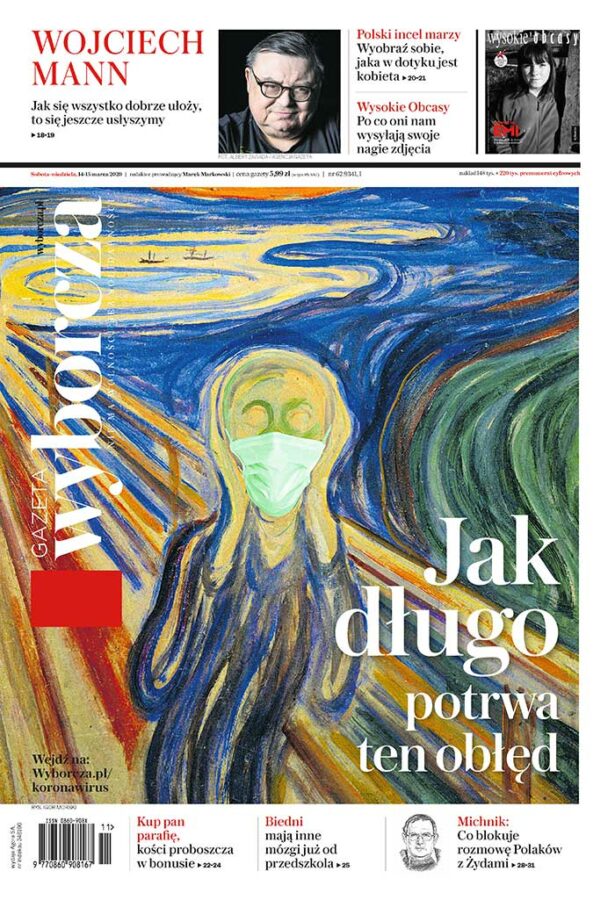
The cover of Gazeta Wyborcza from 14 March 2020 | Scans from texts by Magdalena Ślawska, PhD, DLitt, Assoc. Prof.