





| Prof. Evgeny Galuskin, Prof. Irina Galuskina |
In early 2026, the Commission on New Minerals, Nomenclature, and Classification of the International Mineralogical Association (CNMNC-IMA) accepted a new mineral from the iron meteorite Morasko with the formula K(Ti7Cr)O16 (DOI: 10.1180/mgm.2026.10199). The mineral was named “copernikite” in honour of Nicolaus Copernicus (1473–1543), a renowned Polish astronomer and creator of the heliocentric model of the Solar System.
The team studying the new mineral included scientists from several research centres: Prof. Evgeny Galuskin and Prof. Irina Galuskina (Faculty of Natural Sciences, University of Silesia), Prof. Andrzej Muszyński (Institute of Geology, Adam Mickiewicz University), Prof. Eng. Joachim Kusz and Maria Książek, PhD (Faculty of Science and Technology, University of Silesia), Grzegorz Zieliński, PhD (Polish Geological Institute – National Research Institute).
The metallic background of the Morasko meteorite contains oval troilite-graphite nodules up to several centimeters in size with diverse mineralogy. Systematic studies of nodules of varying composition from the Morasko meteorite have led to a record: copernikite is the fourth new mineral discovered in the Morasko meteorite. Previous discoveries include moraskoite (Karwowski et al., 2015), czochralskiite (Karwowski et al., 2016), and crisaite (Galuskin et al., 2025).
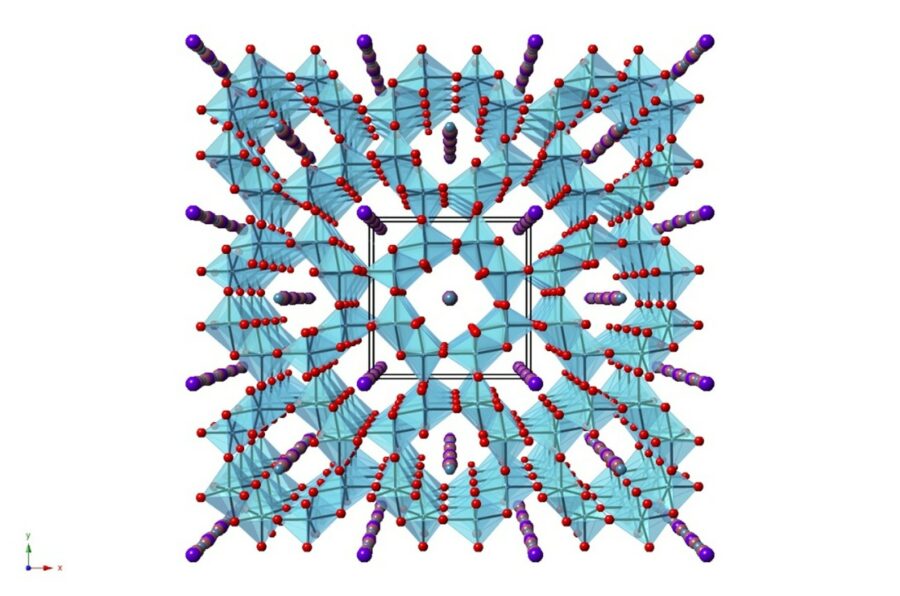
Copernikite belongs to the priderite group of minerals with a tunneled structure. Scientists—“hunters of new minerals”—know that finding a new mineral isn’t that hard; the trick is to scientifically develop it and have it accepted by the CNMNC-IMA commission. Phases, with a composition similar to copernikite, have been known since 1982. These phases were found in lamproites in Australia along with diamonds, but at that time, no comprehensive studies of the composition, structure, or physical properties of these phases were conducted.
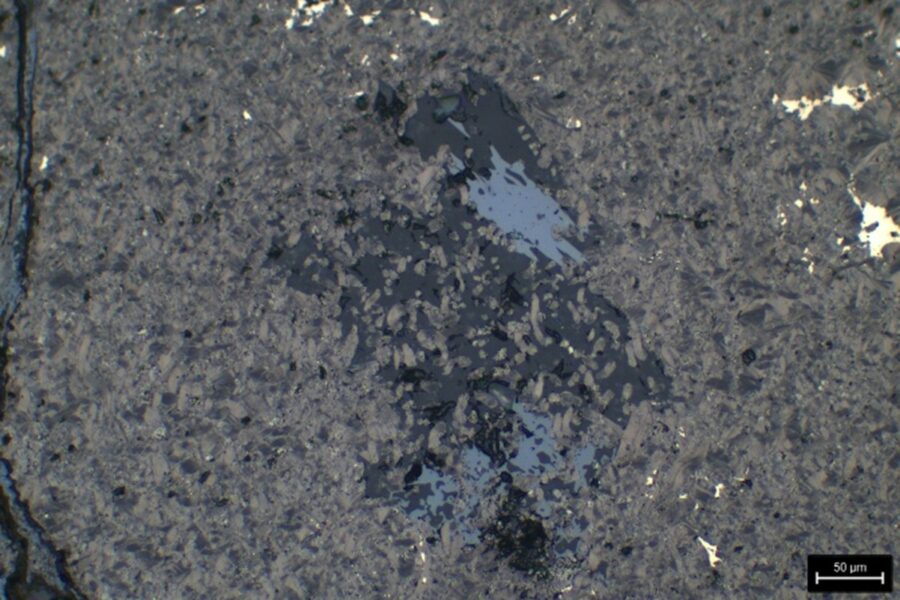
Copernikite was found in only one sample as grains up to 0.3 mm in size (Fig. 1). Copernikite contains chromium, which is responsible for its green color (Fig. 2). Copernikite is the first oxide with a tunneled hollandite structure discovered in meteorites worldwide (Fig. 3).
There is no doubt that systematic mineralogical studies of the nodules from the Morasko meteorite (named after the Morasko district in Poznań), which fell to Earth about 5-6 thousand years ago, will lead to even more new discoveries.
Copernikite is the 80th new mineral discovered by scientists from the University of Silesia, which reflects the world-class level of mineralogical research at the Institute of Earth Sciences.
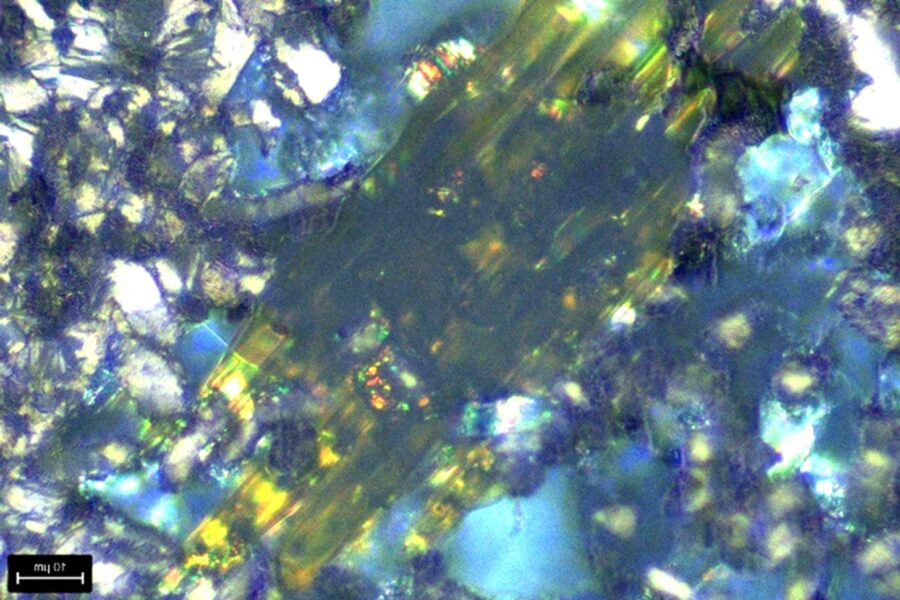
Fig. 2. Copernicite grain, optical microscope.