





| Author: Małgorzata Kłoskowicz, PhD |
What goes through the mind of a simultaneous interpreter, who in a mere fraction of a second must not only comprehend and interpret the spoken words, but also ensure that the conveyed message is clear to the listener? That’s one of the questions posed by Ewa Gumul, PhD, DLitt, Assoc. Prof. from USil Faculty of Humanities. . The initiator and lead researcher of the international CLESI2 project analyses, among other things, the phenomenon of explicitation. This process involves adding to the target text various elements that are not present in the source text, allowing what was merely implicit to be explicitly stated.
Additional words
The word explicitation may sound rather complex to a layperson. Yet, it is part of an interpreter’s everyday work.
‘We speak of explicitation when certain information has been expressed explicitly in the target language, even though it was only implied in the source language.,’ explains Ewa Gumul. ‘To put it simply, it involves adding linguistic elements to the target text or highlighting specific meanings, which often leads to the text being longer and more precise compared with the source one,’ she adds.
Explicitation occurs, for instance, when a personal pronoun (he or she) is replaced with the person’s full name or profession. It also includes using connectors or discourse markers in order to organise content. These can include prepositional phrases like at the beginning, conjunctions like so or even metatextual expressions like in other words. Although these are often used in written translation, they were not expected to appear in simultaneous interpreting.
As the researcher emphasises, even in the 1990s experts believed that the immense time pressure left simply no room for explicitation in interpreting. However, systematic research carried out since 2006 shows something completely different.
‘We knew that in written translation, where we have time for reflection, explicitation is used primarily to improve text quality. The work of a simultaneous interpreter however is a completely different reality,’ says the researcher.
She emphasises that this strategy does not alter the meaning of a text. Instead, it may improve overall text quality through linguistic clarity and logical coherence. Sometimes, it can shift the focal point of a statement. Replacing a noun phrase with a verbal one, for instance, can highlight a person’s guilt or involvement by naming the agent. In this sense, explicitation may be used as a tool of linguistic manipulation.
Less than two seconds
To better understand the meaning of explicitation in simultaneous interpreting, let’s step into the shoes of an interpreter for a moment. Imagine working at an academic conference. While listening to the speaker, you must immediately understand the message and interpret it into another language, so that the recipients can understand what is being said in real time.
The term Ear-Voice Span (EVS) is crucial here. It refers to the time lag between the source text and its interpretation, which is characteristic of simultaneous interpreting. To interpret a sentence accurately, an interpreter needs to wait for a sufficient segment of the utterance first. As this time lag extends, it can result in prolonged silences in the interpreter’s output. If pauses are longer than two seconds, listeners subconsciously perceive them as an omission of content. As a result, the perceived quality of the work is lower, which can undermine the client’s trust in the expert’s performance.
Therefore, it comes as no surprise that simultaneous interpreters use various strategies to deal with these pauses. Explicitation is a case in point. Interestingly, while its main purpose in written translation is to make the text more understandable to the reader, in simultaneous interpreting, explicitation is one of many masking strategies in the interpreter’s arsenalSuch strategies ensure the fluency of delivery, thereby building the client’s trust.
‘In this way, the interpreter gains time when the information is unclear, allowing for more space to comprehend and properly interpret a more challenging extract,’ explains Ewa Gumul. ‘This leads us to another term I find particularly interesting – cognitive load, which refers to the mental effort involved in simultaneous listening and speaking. Our research shows that when it comes to simultaneous interpreting, explicitation is primarily used to reduce this load. That’s a surprising finding,’ she adds.

Ewa Gumul, PhD, DLitt, Assoc. Prof. | Photo by Magdalena Makar
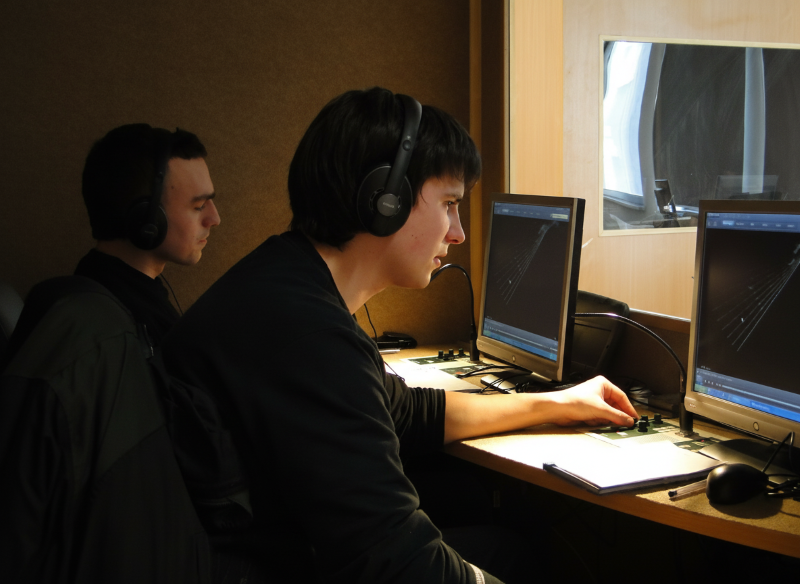
Interpreting booth | Photo by Ewa Gumul
Linguistic fingerprint
Like any language user, an interpreter has what might be described as one’s own linguistic fingerprint. It’s a unique way of formulating statements: lexical and syntactic preferences as well as the tendency to use certain strategies like explicitation.
As Ewa Gumul explains, from this viewpoint, the research findings on Polish interpreters in the European Parliament are highly compelling. The research showed that these simultaneous interpreters employ explicitation in completely different ways, despite a similar professional background and daily cooperation within a well-integrated language unit.
‘Some are highly economical, while others exhibit an extremely “lavish style”. Most importantly, both approaches lead to excellent interpreting quality,’ notes the researcher.
Language pairs: Polish-English and Spanish-English
Based on her analysis of both explicitation and cognitive load in professional simultaneous interpreting, Ewa Gumul found them to be fascinating research topics. This led to the creation of the CLESI1 project (Cognitive Load & Explicitation in Simultaneous Interpreting), which was carried out together with researchers from several academic institutions and funded by the National Science Centre.
‘We focused on the Polish-English language pair. In fact, it was the first project where explicitation in simultaneous interpreting was analysed on such a large scale with the participation of professional interpreters,’ says the project’s principal investigator.
Studying such an elusive process requires combining multiple tools. As the researcher explained, retrospection was one of the methods used. It consists of reconstructing an interpreter’s thought process right after completing a task. However, researchers have to take limitations and distorted memory into account. Memory traces of a completed task may easily blend with experiences from previous professional situations. Furthermore, interpreters may unconsciously rationalise their own decisions, presenting the interpreting process in a way that aligns with the established quality requirements, rather than what was actually going on in their minds. Therefore, to minimise these influences, the participants learnt the exact purpose of the research only after its completion. This was to reduce the risk of them consciously focusing on the analysed phenomena during interpreting and retrospection. Naturally, the researchers also analyse the interpretation itself.
The research findings of the CLESI1 project proved so intriguing that Ewa Gumul decided to extend the scope of the study to a new language pair: Spanish-English.
‘I hold degrees in both English and Hispanic Studies. Therefore, I decided it was worth comparing the strategies used by professional simultaneous interpreters in a second language pair to see whether any of them were universal. Moreover, I hope that in this way, we will avoid the influence of specific systemic linguistic differences on the study results. This led to the creation of the CLESI2 project, which was also made possible by the National Science Centre’s support,’ says Prof. Gumul.
Researchers from the international team seek to answer two main questions: how different levels of cognitive load affect explicit behaviours of professional simultaneous interpreters and whether it is possible to observe recurring patterns in the work of a given interpreter.
The CLESI1 project is carried out by: Ewa Gumul, PhD, DLitt, Assoc. Prof. – principal investigator, Pawel Korpal, PhD, DLitt (Adam Mickiewicz University, Poznań), Katarzyna Liber-Kwiecińska, PhD (Jagiellonian University, Kraków), Marcelina Pietryga, PhD (University of Silesia), Prof. Magdalena Bartłomiejczyk (University of Silesia) and Prof. Jessica Pérez-Luzardo Díaz (ULPGC, Spain). The CLESI2 project team includes: Ewa Gumul, PhD, DLitt, Assoc. Prof. – principal investigator, Prof. Jessica Pérez-Luzardo Díaz (ULPGC, Spain), Prof. Macarena Pradas Macías (UGR, Spain), Prof. Carmen Toledano Buendía (ULL, Spain).
The article ‘Inside Simultaneous Interpreter’s Mind’ was published in March issue No. 6 (366) of University of Silesia Magazine.