





| Weronika Cygan-Adamczyk |
Mermaids, the Kraken, dragons, phoenixes—fantastic creatures that have firmly taken root in our cultural consciousness. We read about them in books, see them in movies, and face them in video games. Without them, the worlds of Harry Potter and The Witcher—along with many other iconic stories—would not exist. These supernatural beings of our modern imagination came into existence centuries ago, and we find traces of many of them as far back as antiquity.
A fascination with supernatural phenomena and creatures is clearly evident in human culture and history, but the reasons for and circumstances surrounding this interest have varied across different eras.
‘It all depends on how one defines the term “supernatural”. Today, we often assume that what is “natural” is synonymous with what is “real”, while the supernatural is considered unreal. In antiquity, however, especially in Christian communities, angels and demons were “supernatural,” but in the sense that they were, so to speak, above the natural world, rather than “unreal.” They were part of the reality of the contemporary peoples who believed in them”, explains Dr Ryan Denson, a literary scholar from the Faculty of Humanities and a member of the Centre for Byzantine Studies at the University of Silesia.
In his work, he examines how ancient societies—particularly those of the Byzantine Empire, Greece, and the Roman Empire—perceived various supernatural creatures and phenomena, including their origins. He does not limit himself to their origins, however, as he also analyses the modern reception of these figures. In one of his book chapters, he has examined the phoenix, whose origins date back to ancient times and which early Christians regarded as an animal equivalent of the Resurrection of Jesus. Today, we often associate the phoenix with the Harry Potter series, where the bird’s ability to be reborn is also depicted on screen.
Orca in monster disguise
How did it come to be that ancient cultures, alongside the dogs, cows, and horses they knew so well were sometimes also convinced of the existence of a whole menagerie of fantastical creatures? Their creativity continues to inspire countless authors and game developers to this day. The highly anticipated premiere of Christopher Nolan’s film The Odyssey is proof that our fondness for ancient tales and myths remains deeply rooted within us.
According to Dr Ryan Denson, many supernatural creatures are derived from real animals. In his book Zoobiography of the Ancient Sea Monster, Denson explores which real-life animals might have reminded people of certain monsters. It is not hard to imagine how a terrified sailor might have ended up turning a whale into a fearsome leviathan.
‘Today, everyone is familiar with mermaids and centaurs, which were already known in ancient Greece. Not all monsters, however, are so easily recognizable, and one such example is the Greek sea monster kētos, which has essentially been lost in modern culture. It seems to have combined elements associated partly with fish, partly with snakes, and even with dogs—in other words, animals that were familiar to the inhabitants of the ancient Mediterranean basin’, explains Dr Ryan Denson.
Could today’s orcas, dolphins, or sharks have reminded some ancient cultures of the predatory creatures straight out of horror movies? Most likely, yes, especially if they attacked a person or a boat. Interestingly, nowadays we sometimes hear in the media about dangerous interactions between smaller vessels and certain cetaceans, but this usually stems from human carelessness or the animal’s simple curiosity. In the past, however, such encounters could escalate into an attack by a dangerous creature.

Dr Ryan Denson | private archive
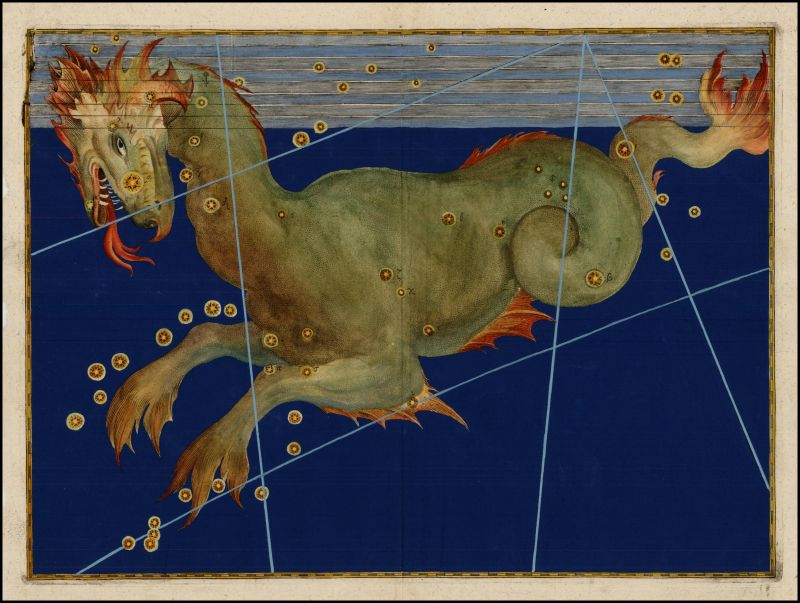
Depiction of the sea monster Ketos in Johann Bayer’s Uranometria (17th century) | public domain via Wikimedia Commons
Human-animal hybrids
Among many ancient monsters, we often find those that combine human and animal features. The Minotaur, mermaids, harpies, sphinxes, and many deities in the mythologies and religions of ancient civilisations were such hybrids. On the one hand, this still connected them to humans; on the other, it elevated them to the status of fantastical and unusual figures in ancient art and literature.
Denson notes that similar images have accompanied humans since the dawn of time and are likely a manifestation of a deeper fascination with the supernatural. As an example, he points to a small (no more than 30 cm) ivory figurine found in 1939 in a cave called Hohlenstein-Stadel in Germany. Known as the Löwenmensch, or lion-man, it is dated to 40–38 thousand years ago, predating all of human written culture.
‘These kinds of hybrids, familiar to us from mythology and ancient beliefs, are a natural consequence of humanity’s close relationship with nature. We didn’t just hunt animals; we also formed close bonds with many, such as dogs, horses, and other domesticated species. This intertwining of the two worlds—human and animal—must have been incredibly fascinating to our ancestors since time immemorial’, explains Dr Ryan Denson.
Did they really believe that?
Stories about dragons, sea monsters, or bizarre hybrids sound exciting even (and perhaps especially so) for modern audiences—the unflagging popularity of fantasy seems to bear clear witness to this. However, no one seriously expects to see a griffin flying overhead, nor do most of us think that Cthulhu is actually sleeping soundly at the bottom of the ocean. Perhaps there were also those among the ancients who viewed about such figures with scepticism?
Denson further argues that although we find attempts in the sources to explain supernatural phenomena in a more rational way—from a modern perspective—these are, however, quite rare when it comes to the distant past. One such attempt was made by an author known as Palaephatus, who sought to explain the meaning of the myth of Andromeda. Perseus saved her by defeating the sea monster kētos, which was about to devour her. This is the very same monster which was so variable in the ancient imagination. Palaephatus rationalised that in that story the monster might have been nothing more than an ordinary pirate ship that attempted to kidnap the woman, and that this story was later embellished to such an extent that it gave rise to a separate myth.
However, we shouldn’t be too harsh on earlier cultures, which viewed supernatural phenomena as reality. They tried to explain the world they observed in every possible way, and after all, they didn’t have any of the advanced technologies of the modern world.
‘Even today, with all our advanced technology, we haven’t fully explored the ocean floor. We’re still discovering new and surprising things. Ancient societies, of course, had no way of descending into the depths to explore them, so their experience was essentially limited to the surface. That is why people often filled in these gaps with terrifying monsters, because only monsters could make sense of what they encountered or observed’, explains Dr Ryan Denson.
Vampires, werewolves, and other fantastical creatures thus stand as a testament to humanity’s fascinating quest to understand the reality around us. Thanks to these efforts, as well as the immense creativity, we can enjoy many iconic works of pop culture. These, in turn, serve as a rich source for interpreting social changes and the evolution of human thought.
‘One of my other projects analyses Marvel superheroes in the context of certain ancient themes. For my part, I compare ancient and modern depictions of werewolves with the image of the Hulk, drawing on the entire Marvel universe. This volume is being put together by an emeritus professor of ancient philosophy, so we’re asked to tease out philosophical meanings behind disparate narratives. My chapter explores the ethics of transformation in relation to identity. Is a lycanthrope the same person in human form and werewolf form despite obvious differences in form, behaviour, and memory? Likewise, are Bruce Banner and the Hulk the same person? This chapter will look at these questions and with this comparative analysis of a traditional folkloric monster and a modern hero to explore what these narratives reveal about personal identity’ says the literary scholar.
Although our perceptions and understanding of the supernatural have changed over the centuries, our enduring fascination with these subjects remains a link between us in the 21st century and cultures of antiquity.
The article entitled ‘Fantastic Beasts and Where to Find Them in Culture’ was published in the May–June issue of Gazeta Uniwersytecka UŚ (USil Magazine), no. 8–9 (338–339)