




Several changes to the spelling rules came into effect on 1 January 2026. Among other things, they relate to the use of capital letters and whether certain words should be written jointly or separately. The changes that aim to simplify and standardise the Polish spelling rules have sparked a conversation about how language adapts to the modern world and why promoting language etiquette matters. Katarzyna Wyrwas, PhD, DLitt, Assoc. Prof. from the Faculty of Humanities of the University of Silesia in Katowice – the winner of the POP Science Award 2025, who has been running the USil Language Clinic for 20 years now – talks about language as a tool for communication and mutual understanding.
MAŁGORZATA KŁOSKOWICZ, PHD: Who oversees what is considered correct in Polish?
PROF. KATARZYNA WYRWAS: Spelling can be changed by the Council for the Polish Language (Rada Języka Polskiego). It provides evaluations and assessments on matters concerning the use of Polish. Its activities are outlined in the Polish Language Act of 1999. The results of the Council’s work can be seen on its website, in publications and reports on the state of protection of the Polish language presented to the Sejm and the Senate. Throughout the years, the Council has introduced some changes in spelling and addressed important issues concerning social communication.
It’s different when it comes to inflection or word formation. After all, language is not imposed on us but rather co-created by us all. Prof. Irena Bajerowa, a distinguished scholar, historical linguist and the founder of the USil Language Council, once wrote: ‘Language is the most democratic human creation – by speaking and writing, the entire society votes for certain linguistic forms and thereby chooses those which serve human communication better. Linguists, however, try to guess which form would be more suitable and useful’. Linguists describe and organise the language as well as provide materials, tools and examples. They comment on deviations from the norm and promote grammatically correct forms. The final form of the language, however, depends on us – Polish users. Language is a social creation – one we are all responsible for. Ultimately, our choices in how we speak and write are the driving force behind how it changes. Every single one of us can influence the Polish language. We see the effects of this every day – with countless examples of how the language is evolving. A few decades ago, we started inflecting the nouns radio and studio. Today, we do the same with logo. In Old Polish, our ancestors prayed somebody (prayed God). Next generations prayed to somebody (prayed to God). In the Polish 19th-century book The Doll by Bolesław Prus, we can also observe some linguistic changes – the declined form of the word fotel (armchair), for instance. In the book, when Izabela Łęcka is rising from an armchair, the form z fotelu is used. Although this form is still considered correct, nowadays, people more commonly say z fotela. In the same book, the verb wyrządzić (to inflict) was used in an interesting way. It was combined with the nouns krzywda (harm) and szkoda (damage) – and it is still used in this way today. However, combinations that are out of use now, like wyrządzić honor, zaszczyt (to inflict privilege, honour) were also present. We can see that the meaning of the word wyrządzić (to inflict) has changed and it is only used in the negative sense nowadays. People coin new words which then enter common usage, even before being officially listed in dictionaries. These include words like kaszotto (a buckwheat dish; blended from kasza [groats] and risotto), niekapek (a sippy cup; derived from the prefix nie- [non-], the verb kapać [to drip] and the noun suffix -ek) or internisaż (an online art exhibition; blended from internet and wernisaż [vernissage]). Because of us, words sometimes change their meaning. The word nostalgia, for instance, used to only refer to the longing for one’s native land. Now, it is often used to describe a bittersweet longing for the past. Not all of these new developments gain widespread social approval or are endorsed by linguists. In the end though, it’s society that decides which forms to use and which to forget about. Forms that are useful and popular eventually find their way into dictionaries. In Polish, the word dzban (jug) gained a new, colloquial meaning – a fool or somebody who did something stupid. This meaning has already been listed in Wielki słownik języka polskiego PAN (The Great Dictionary of the Polish Language of the Polish Academy of Sciences). However, there are words that have another meaning which this dictionary does not include – adoptować (to adopt), as in take animals from a shelter, foundation or foster home under one’s care, or znajomy (acquaintance), as in Facebook friend. Some changes can be quite surprising. In the 19th century, for instance, the word kolaboracja (collaboration) meant ‘working together’. During World War II, the word gained a new, negative meaning – working with an enemy. Nowadays, some people view it as a neutral word, while others view it as a negative one, which can lead to miscommunication.
MAŁGORZATA KŁOSKOWICZ, PHD: Meanwhile, the Council for the Polish Language introduced a series of changes to the Polish spelling. What led to sentences like Nienajwyższa Katowiczanka przyjechała Fiatem being considered correct since 1 January 2026 (with the joined spelling of nie with a superlative adjective and capitalised spelling of the names of city residents and car brands)? Which of the changes do you find the most important?
PROF. KATARZYNA WYRWAS: The 2026 spelling reform wasn’t random. The changes were made on the basis of how Polish people actually spell the words. They aim to simplify rules that were not precise enough and which had many exceptions. During my classes, I would show my students posters and flyers with incorrect spelling of the names of city residents – for instance, Drodzy Katowiczanie (Dear residents of Katowice). The capitalised spelling of Katowiczanie was not necessarily an act of ignorance but rather an act of respect towards the recipients. The last reform takes that into account. Now, names referring to the residents of cities, districts or villages should be spelt with a capital letter, e.g. Katowiczanin (resident of Katowice), Ligocianin (resident of Ligota), Łodygowiczanin (resident of Łodygowice). This standardises the spelling, which was an illogical exception to the general rule – names referring to people from continents (Europejczyk – a European), countries (Polak – a Pole) or regions (Ślązak – a Silesian) had already been capitalised. The spelling of the negative particle nie (not) with inflected participles is another important change. In this case, the words used to be written either jointly or separately, depending on their meaning – adjectival or verbal – which was a source of constant doubt. The rule has been simplified, and now everything is written as one word, e.g. niebędący (not being), niepalący (non-smoking). Another change concerns paired, rhythmic expressions that sound similar or identical and usually appear together. There were different rules for different expressions. Now, there are officially three correct ways of spelling them – hyphenated (tuż-tuż), separated with a comma (tuż, tuż) or separated with a space (tuż tuż). The important thing is to choose one form and use it consistently within a text. I think that standardising the spelling of company and brand names is also an important change. Fiat, for example, as a brand name, used to be written with a capital letter. When the word referred to a specific car, however, it was written with a lower-case letter. In reality though, people didn’t follow that rule – especially in the automotive press. The reform simplified it to align with how people actually write, making spelling more intuitive for everyday communication. It’s worth mentioning that the Orthography Reform Team included the distinguished linguist Danuta Krzyżyk, PhD, DLitt, Assoc. Prof. from the USil Institute of Linguistics, who – just like Professor Aldona Skudrzyk – is a co-author of the new dictionary that incorporates the new spelling rules.
MAŁGORZATA KŁOSKOWICZ, PHD: These changes are important for people who work with the Polish language on a daily basis. They will be taught at school, they will interest those who are passionate about Polish… and that’s probably about it. I believe that language awareness is a crucial thing here. It’s about the fact that even if you are not a linguist, as a speaker, you can still be aware of how you speak and decide to use your language consciously. Today, many people talk about the impoverishment of Polish and its widespread vulgarisation in public spaces. Why does the way we speak and write matter?
PROF. KATARZYNA WYRWAS: Although I usually visit schools to give lectures to last-year students, I keep hearing that students are reading less and less. That’s a real problem. If social media and the videos with questionable content become the only model for communication, then language is bound to become impoverished. Classical literature, non-fiction, quality reportage and biographies not only teach empathy and offer insight into human experiences, but above all, they serve as a source of rich, beautiful language, showing readers how to construct longer and logically structured arguments. Developing language competence is the role of schools, yet teachers are raising concerns about the decline in the language skills of children and young people. It comes as no surprise – if students don’t read set books, they won’t develop a rich vocabulary. When we look at online communication, we see sloppiness, chaos, a lack of punctuation and disregard for basic spelling rules, such as capitalising surnames or place names.
Yet, language is a tool for thinking and a vital part of our cultural capital. Correctness is not simply a matter of aesthetics – it helps clarify our thoughts and shapes the quality of our argument. Rich vocabulary helps us capture the subtle difference between words like regret, sadness and melancholy. Precise communication helps us express ourselves better and reduces the risk of misunderstandings. The way we speak and write reflects our education and competence levels, building credibility with our listeners or potential employers.
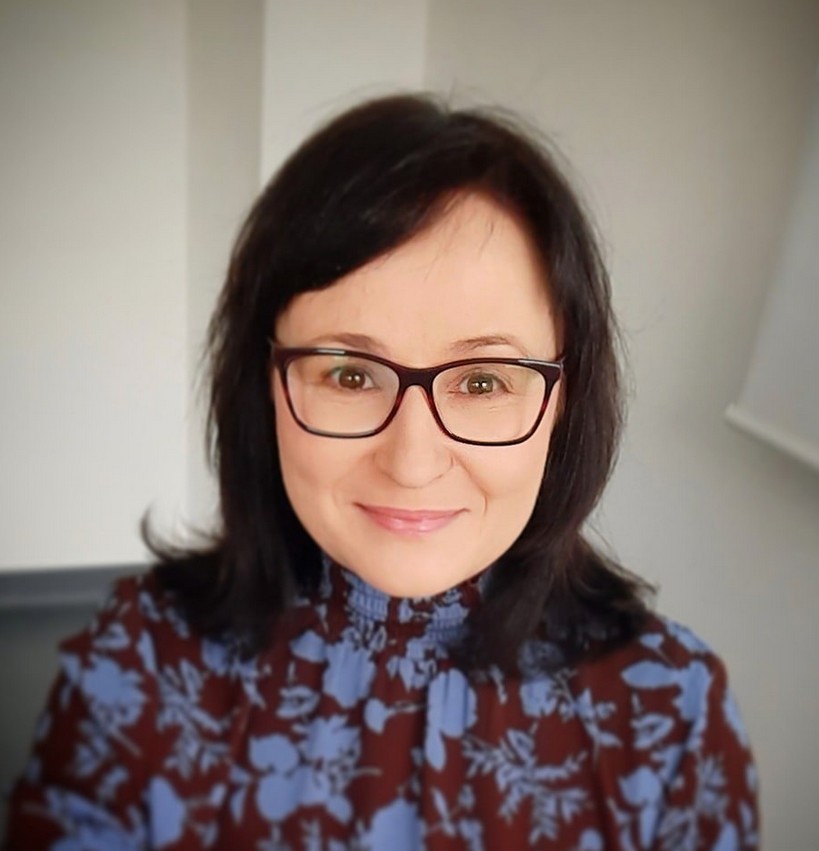
Katarzyna Wyrwas, PhD, DLitt, Assoc. Prof. | private archive
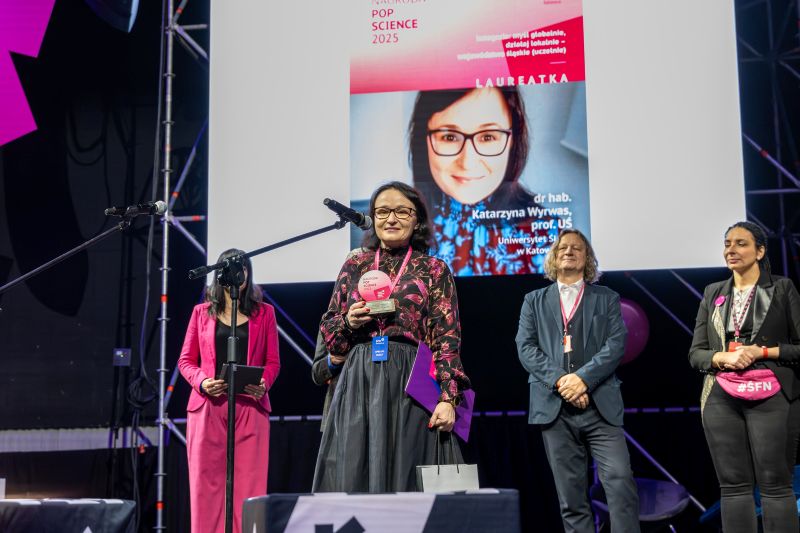
Katarzyna Wyrwas, PhD, DLitt, Assoc. Prof. during the POP Science Awards Ceremony at the 9th Silesian Science Festival Katowice | photo by Matylda Klos
MAŁGORZATA KŁOSKOWICZ, PHD: The vulgarisation of language in public space leads to its impoverishment.
PROF. KATARZYNA WYRWAS: This is not a contemporary problem – vulgarisms are an integral part of language. In the past, however, there were strong cultural and societal barriers, so people didn’t use them as often. Now, vulgarisms seem to be losing their taboo status. The adjective z…y (f…g awesome), for example, is used to describe something positive, enthusiastic and often replaces adjectives like excellent, superb, wonderful or fantastic. Today, vulgarisms are very often viewed as a sign of authenticity or being your true self. Within peer groups, they can even help foster a sense of community. The USil Language Clinic once received the question: ‘Is the word z…y vulgar?’ Many people probably don’t perceive it as such any more… We are constantly exposed to violent content in pop culture and public discourse. As a result, we may eventually stop reacting to it. In psychology, this phenomenon is known as desensitisation.
MAŁGORZATA KŁOSKOWICZ, PHD: The USil Language Clinic has been running for 22 years. What questions do Polish people ask? Are there any ‘immortal’ questions?
PROF. KATARZYNA WYRWAS: There are questions that are asked regularly, which goes to show that certain rules of the Polish language are complicated for us. What people usually find the most difficult is whether a word should be written jointly or separately, and the use of uppercase and lowercase letters as well. Many questions are about abbreviations – their spelling and declension. However, most questions definitely concern the inflection of surnames. Very often, people claim that their surname can’t be inflected – because of their origin, for instance. I remember a case that involved a surname of Czech origin. The owner took offence at a clerk who inflected it in an official document. People are very attached to their surnames, but… it’s grammar, not people, that makes the rules of inflection.
MAŁGORZATA KŁOSKOWICZ, PHD: Which questions surprised you the most?
PROF. KATARZYNA WYRWAS: Somebody once asked about the names for residents of certain villages: Lenie Wielkie (Big Lazybones), Swornegacie (Orderly Pants), Grzeczna Panna (Polite Maiden) and Niemyje-Ząbki (Unwashed Teeth). I thought it was a joke, but since I always take all the questions seriously, I checked the official registry. As it turns out, all these places actually exist! I answered that Lenianie, Swornegacianie, Grzecznopannianie and Niemyjanie live there.
Wikipedians ask interesting questions. I once answered a question about localising the name of a Mayan tribe living in Guatemala and Mexico. After a thorough analysis, I proposed the form Czuhowie. What was the problem? Well, in Spanish, the tribe is called… Chuj, which, needless to say, would be rather controversial in Polish (as it is the Polish word for dick). Ultimately, the tribal name Czuhowie and the language name czuh were accepted as recognised forms on Polish Wikipedia.
MAŁGORZATA KŁOSKOWICZ, PHD: Your work at the USil Language Clinic is just a small part of your academic output, but it was precisely your outstanding achievements in science communication that earned you the POP Science Award 2025 at the Silesian Science Festival Katowice. What does this recognition mean to you?
PROF. KATARZYNA WYRWAS: The POP Science Award is very important to me because it acknowledges my long-term activity outside the academic community. Scientific research, publications and teaching are part of my daily routine. Science communication, however, requires slightly different skills – it takes the ability to effectively translate complex, specialised knowledge into a language that is accessible to a wider audience. Prof. Jan Miodek used to say that complex matters can and should be discussed in a simple way – that there is no field of knowledge, from differential calculus to language processes, that cannot be explained to a layperson in plain terms. I try to follow this path through the USil Language Clinic website, our social media and the radio broadcasts on which I have been appearing for many years. For me, the POP Science Award confirms that science can – and should – exist in dialogue with society. I believe that promoting knowledge about the Polish language – which, after all, is our national treasure – shapes how the average person views Polish and what they think about communication, science and the university. In this sense, the award is important to me not only professionally but also – and perhaps above all – socially. I am grateful for the many years of cooperation with numerous outstanding linguists who see the deeper meaning in spreading linguistic knowledge. I would like to thank them all from the bottom of my heart! Every question we received was also vital, because language is a product of society. Therefore, it is up to us, Poles, to seize the opportunity to thoughtfully care for its development together. May the Polish language remain a perfect tool for communication and mutual understanding.
MAŁGORZATA KŁOSKOWICZ, PHD: Thank you for the interview.
*Irena Bajerowa: ‘Ci biedni językoznawcy, czyli kłopoty z kulturą języka’ (Those Poor Linguists: Troubles with Language Culture), in: www.poradniajęzykowa.pl, editor: Katarzyna Wyrwas, University of Silesia Press, Katowice 2007, page 9.
The article entitled ‘Tool for Thinking. Conversation about the Polish Language’ was published in the April issue of the University of Silesia Magazine, no. 7 (337).