





| Magdalena Nowacka-Flakiewicz, MA |
In the works of Henryk Baranowski (1943–2013) – director, emigrant, teacher, philosopher, and actor – travel was not only a geographical experience but also a spiritual necessity and an artistic tool. He directed over 60 theatre and opera productions in Europe, Russia, and the USA. From the stages of Warsaw to Kreuzberg in Berlin and New York’s experimental theatres, Baranowski was constantly on the move, crossing cultural and aesthetic boundaries and pushing his own limits. He was not afraid to experiment. His life and theatre represent a multidimensional journey through eras, places, and ideas, as well as a record of transgression, transformation, and the search for meaning. At a time when the world around us remains in constant motion, his art proves surprisingly relevant.
Henryk Baranowski studied mathematics at the University of Wrocław and graduated in philosophy from the University of Warsaw (1968) and in directing from the State Higher School of Theatre in Warsaw (1973). He directed, designed stage sets, wrote screenplays, produced radio plays, and staged his own productions for Teatr Telewizji (Television Theatre). He left behind a volume of poetry, voice recordings, and recordings of his performances. He played the lead role in Krzysztof Kieślowski’s Dekalog I (1988) and Napoleon in Andrzej Wajda’s Pan Tadeusz (1999). The themes of wandering, exile, identity, and return were recurring motifs in his performances.
Between 1967 and 1980, he directed many significant works of world drama (including Genet, Ibsen, Handke, O’Neill, and Kafka) and Polish drama (including Gombrowicz, Fredro, Mickiewicz, and Kajzar) on Polish stages, often as his own adaptations. After his controversial staging of Dziady (1977), Baranowski was blacklisted, which prevented him from continuing his artistic career in Poland. In 1980, he was forced to emigrate and ended up settling in a Berlin district populated by artists, migrants, and rebels. This decision changed his life and his art. This is where he founded Transformtheater (1981–1992) – a place that was simultaneously a stage, a school, and a refuge for people from all over the world. The group gained Europe-wide recognition and participated with great success in international festivals in Germany, Portugal, Italy, and the Netherlands, among others. Born out of alienation and nourished by hope, the theatre became a space for transformation, a map of personal and social change.
Many of Baranowski’s productions were staged abroad. Theatres in Berlin, Cottbus, London, Oslo, New York, Chicago, Las Vegas, Novosibirsk, Omsk, and St. Petersburg welcomed his theatre and opera productions, combining classicism with avant-garde, spirituality with physicality and various forms of artistic expression. He also put his artistic skills to use in his educational work, mainly abroad. While in the United States, he directed Tabori’s Peepshow with his own set design (winning the 1992 Joseph Jefferson Award for Best Ensemble of the 1991/1992 season), Kafka’s The Trial at the University of Tennessee, Różewicz’s White Marriage at New York University, Aeschylus’ Oresteia in Knoxville, and Genet’s The Balcony at Judy Bayley Theatre, University of Nevada, Las Vegas.
In the early 1990s, the artist received the ITI Award for promoting Polish culture and an award from the Minister of Foreign Affairs (1993) for his work and outstanding contributions to the promotion of Polish art abroad.
The stage was everything to Baranowski. In the later part of his career, he focused largely on operas. His staging of Philip Glass’s Akhnaten at the Grand Theatre in Łódź received widespread critical acclaim and won him the Golden Mask Award for the best director of the 1999/2000 season. He has also worked with Russian theatres. In 2004, he received the Russian Golden Mask for the best opera production in Russia in 2003 for his staging of Alfred Schnittke’s Life with an Idiot at the Novosibirsk Opera and Ballet Theatre in co-production with Hahn Produktion in Berlin.
Looking back at his correspondence, scripts, and memoirs, it is clear that he saw the concept of homo viator (traveller) not only as a philosophical metaphor but as an everyday experience. In the last years of his life, he struggled with cancer. He wrote about it candidly in his 2013 autobiography, Spowiedź bez konfesjonału Wędrówki pomiędzy sztuką, magią i medycyną (Confession without a Confessional. Wanderings between Art, Magic, and Medicine) – without pathos: about the pain that reveals something and coming to terms with one’s fate. His last journey was an inner one. However, it was no less intense than those that came before. ‘I finally found happiness that was always so close – within me’ is an insight by Baranowski that holds the key to understanding his art. The essence of motion is not place, but transformation; finding oneself is the furthest journey one can take.
Today, in a world marked by migration, cultural clashes, and questions of identity, Henryk Baranowski’s art takes on a new meaning. His theatre did not provide ready-made answers, but space – between languages, aesthetics, experiences, and across borders. This is the space we are all desperately searching for today.
The article entitled Henryk Baranowski and his journey through theatre and life was published in the popular science journal No Limits no. 2(12)/2025.
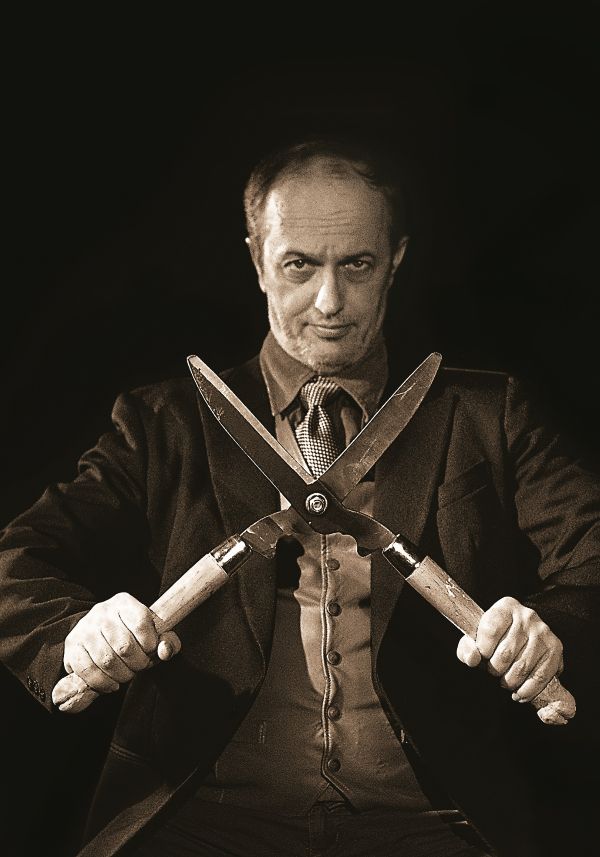
Henryk Baranowski | Photo by Svetlana Bakushina