





| Written by Tomasz Grząślewicz, MA |
‘Anja and I didn’t have where to go’. With these words, Vladek Spiegelman – the protagonist of the comic book Maus: A Survivor’s Tale, created by his son Art Spiegelman – comments on the desperate decision to leave his hiding place within the liquidated ghetto of Sosnowiec-Środula. Holding hands, Anja and Vladek set out in search of a chance to survive, and their desperate plight is embodied by the swastika shape formed by the intersecting roads ahead of them. The other elements visible in the drawing – slag heaps, smokestacks, an industrial plant, and a tenement house – demonstrate the American artist’s good reconnaissance of the area. His famous work was created based on years of research, which included the topography of Sosnowiec – the city where a significant part of Maus is set.
Art Spiegelman’s Maus. A Survivor’s Tale, honoured with the Pulitzer Prize in 1992, is considered a milestone in the recognition of comics as a medium capable of conveying ‘serious’ – in this case, traumatic – subject matter. The plot unfolds across two timeframes. The ‘present-day’ timeline is 1970s New York: following his mother’s suicide, young Art regularly visits his father and questions him about the past. The stories told by Vladek transfer us to the German-occupied Poland, where a Jewish family from the Zagłębie Dąbrowskie region struggles to survive the Nazi hell. The backdrop to a significant part of their story is Sosnowiec – the place where they live and conduct business, then face successive stages of persecution, and ultimately end up in the closed ghetto, from which they are to be deported to KL Auschwitz.
Translated into dozens of languages, Maus has been the subject of numerous scholarly studies and publications. However, the role of Sosnowiec as the work’s setting has not previously been the subject of detailed research. Spiegelman’s comic is often analysed in the context of Holocaust memory, the relationship between survivors and their children’s generation, testimony, trauma, and the comic book form. In Poland, the initial reception of the work was dominated by a discussion – or, more aptly, a controversy – regarding the specific form of graphic representation employed by the artist. In his work, Jews are portrayed as mice, Germans as cats, and Poles as pigs. On the other hand, the public is hardly aware of the connections between the events in the comic and actual locations in Sosnowiec.
Reading MetaMaus, which is a kind of self-commentary on Maus, we gain insight into the author’s creative process. We see the successive stages of the comic’s creation: pop-culture inspirations and references, family trees and photographs, as well as preliminary sketches. Among the source materials accompanying the aforementioned publication, the transcripts of the original conversations between Art and his father are of particular significance.
Vladek does not tell his story in a linear, detached, and orderly fashion. His memory skips about and jumbles the order of events, and on top of that, he passes it on to his son in rather poor English. Art, for his part, shows a great deal of curiosity, asking about aspects of life in Sosnowiec that are unfamiliar to him – such as how the tailoring shops operated, what the backyard sheds looked like, or what the distance between Sosnowiec and Dąbrowa Górnicza is (“as far as from here to New Jersey,” he hears in reply). This striving to understand and convey the truth about their parents’ wartime experiences as precisely as possible resulted in a work deeply rooted in the reality of Sosnowiec. At one time, a letter in which Art Spiegelman protested against the New York Times Book Review’s inclusion of Maus on the ‘Fiction’ bestseller list gained considerable attention. An analysis of the Sosnowiec-related elements in the comic book leads one to agree with the author, despite certain historical inaccuracies and concessions stemming primarily from the nature of the chosen format.
Although more than thirty years have passed since the events described, Vladek provides a wealth of precise information about the places and events that Art later processed in Maus. Sosnowiec’s main shopping street, Modrzejowska, appears in the work several times. During the war, Vladek comes here to conduct illicit business, and his son’s drawing successfully captures the atmosphere of the city’s central hub, with its dense urban fabric and cramped courtyards. Mandelbaum’s confectionery and Szklarczyk’s shop operated on this very street; both establishments are mentioned in the comic. On Modrzejowska, Vladek narrowly escapes a German roundup; as we know from numerous eyewitness accounts, the street was indeed particularly prone to such incidents. A public execution, during which four Jews were hanged, was also carried out here. Although in reality they were hanged from a tree, in the comic we see them on the gallows.
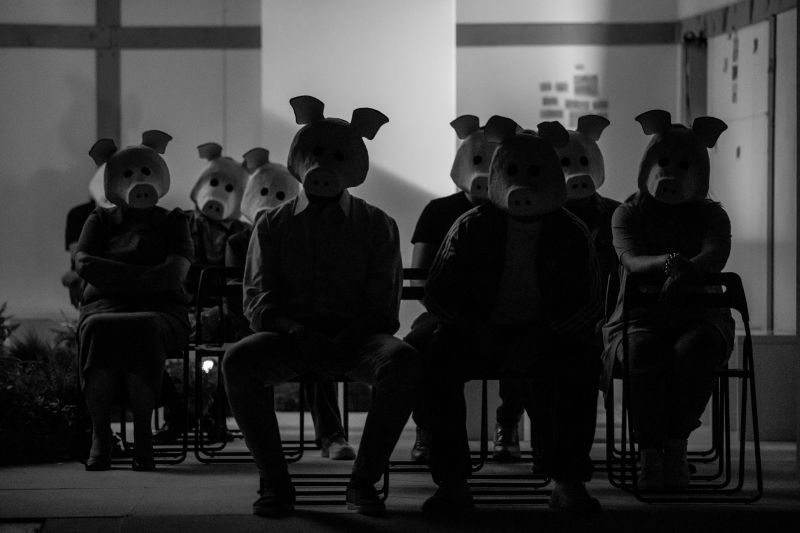
A scene from the play Środula. The Landscape of Maus at the Theatre of Zagłębie in Sosnowiec | Photo: Jeremi Astaszow
Art Spiegelman frequently employs symbols unequivocally associated with wartime trauma and suffering. He did not witness the events he describes; the imagination of a child of survivors is saturated – to use a term proposed by Marianne Hirsch – with ‘postmemory’: an inherited memory constructed from, among other things, stories, photographs, films, and cultural representations. That is why certain details that appear in his comic are rather universal than locally precise – for instance, the barbed wire with which the Sosnowiec-Środula ghetto was not actually surrounded. Details of this kind do not necessarily align with what is confirmed by documents and accounts concerning Sosnowiec. However, they serve an important function: they show how the ‘second generation’ imagines a trauma they could not witness firsthand.
On the other hand, many of the images of Sosnowiec presented by Spiegelman correspond precisely to the facts. In one of the scenes, we look through the window of the tenement house at Kołłątaja 6, co-owned by Israel Zylberberg – Vladek’s father-in-law. A family is sitting at the table, discussing current events during the meal. ‘Each of us gets coupons for 8 ounces of bread a day, and a tiny bit of margarine, sugar and jam per week. That’s it’, comments Vladek’s brother-in-law. The food rations he cited are in perfect agreement with the accounts of surviving witnesses. Equally convincingly portrayed are the circumstances of the so-called stadium selections, which resulted in the deportation of several thousand Sosnowiec Jews to Auschwitz in August 1942. Many accounts of those days contain details strikingly reminiscent of Vladek’s embellished story: thousands of elegantly dressed people on the streets, closed stadium gates, the categorisation of people, and the stamping of documents. As with the previously described execution, here too we find a symbolic element – a railway car placed on the sports field – heralding the impending deportation to a death camp.
From the perspective of a researcher focused on literary topography, relatively easily identifiable landmarks – such as Modrzejowska or the sports fields by Mireckiego Avenue that still exist today – prompt the question: how many more comic book panels can be linked to real-world addresses, people, and events? In the case of less obvious locations, archival German documents, among other sources, prove helpful. It was thanks to them that it was possible to establish that the Szpigelman and Zylberberg families were forced to move three times within Sosnowiec during the occupation. Unfortunately, none of the buildings – located respectively at 1 Maja 17 in the city centre, Matki Teresy Kierocińskiej 8 in Stary Sosnowiec, and Okrzei 54 in the Środula ghetto – has survived to the present day. It is worth noting, however, that the location of these officially confirmed sites aligns with Maus’s narrative, thereby allowing us to place further pins on the map of Sosnowiec based on Art Spiegelman’s work.
The need for such a map is evidenced by the turnout at events organised in 2022–2023 in conjunction with the premiere of the play Środula. The Landscape of Maus at the Theatre of Zagłębie and the 80th anniversary of the liquidation of the Sosnowiec-Środula ghetto. Hundreds of people eager to discover little-known aspects of the city’s history took part in literary-historical walks and lectures on Spiegelman’s comic book at the time. The global popularity of the work – based on extensive research covering areas including Sosnowiec – offers an opportunity to spark international interest in the largest city of Zagłębie Dąbrowskie. A bilingual trail following the path of the graphic novel Maus. A Survivor’s Tale could be the ideal tool for achieving this goal – whether situated in the urban landscape, existing in a virtual format, or perhaps even taking both forms.
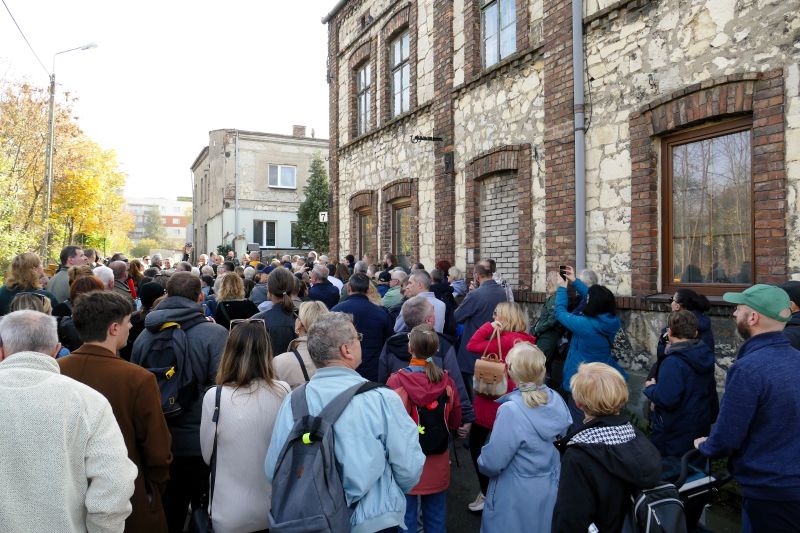
A guided tour of Sosnowiec in the footsteps of Maus | Photo: Artur Ptasiński
The article ‘Spiegelman, Sosnowiec and the art of research’ was published in 1(13)/2026 issue No Limits.
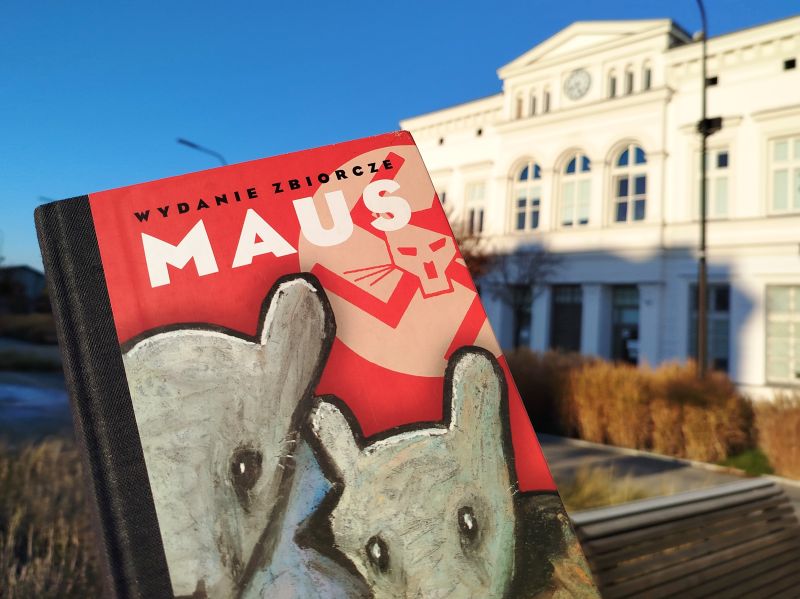
Maus in Sosnowiec | Photo: Tomasz Grząślewicz